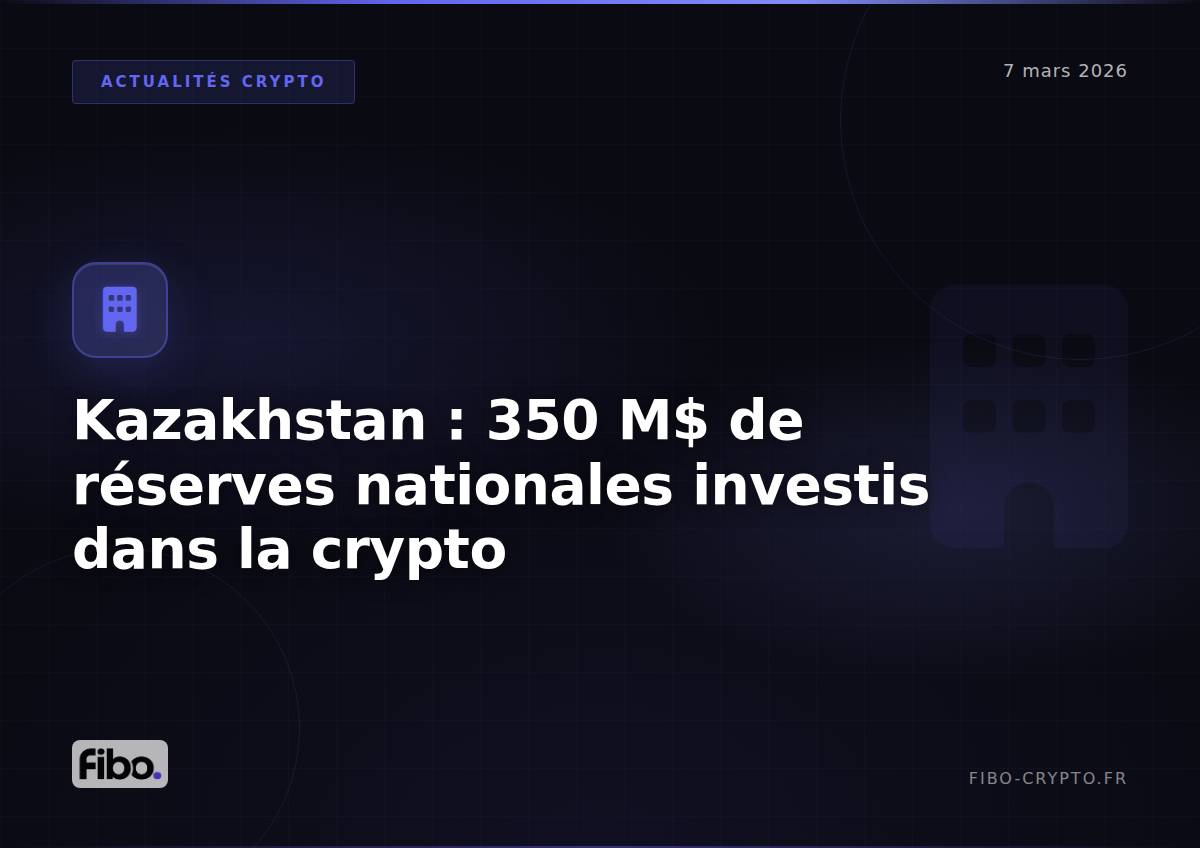
Kazakhstan: Central Bank to Invest $350M of Reserves in Crypto
📋 En bref (TL;DR)
- $350 million: the amount Kazakhstan’s National Bank will invest in digital assets starting April 2026
- Source: the country’s gold and foreign currency reserves, totaling $69.4 billion — a cautious but historic first step
- No direct Bitcoin purchases: the investment will target crypto ETFs, technology companies, and index funds linked to digital assets
- Goal: $1 billion in national crypto reserves by end of 2026, combining central reserves, seized assets, and mining revenues
- Eurasian crypto hub: trading volumes on AIFC platforms have multiplied 20-fold since 2023, reaching €6 billion
- Mining deregulation: Kazakhstan lifted the AIFC’s monopoly and authorized mining and trading throughout the country
$350 Million: The Central Bank Takes Action
On March 6, 2026, the National Bank of Kazakhstan confirmed the allocation of $350 million from its gold and foreign currency reserves into digital assets. This sum, managed by the National Investment Corporation (NIC), will be deployed starting April-May 2026 into financial instruments linked to the crypto ecosystem — crypto ETFs, technology company shares, and index funds.
“We are not talking about a massive investment in cryptocurrencies,” clarified Aliya Moldabekova, vice president of the central bank, emphasizing “a measured approach.” The amount represents approximately 0.5% of the country’s total $69.4 billion in reserves, but it marks a symbolic turning point: Kazakhstan becomes one of the rare states to mobilize its sovereign reserves for exposure to crypto markets.
An Ambitious Sovereign Crypto Fund
The $350 million is only a first tranche. Kazakhstan aims to build a national crypto reserve fund that could reach $1 billion by the end of 2026. This fund will combine three distinct funding sources:
- Central bank reserves (via the NIC)
- Seized cryptocurrencies from judicial proceedings
- Tax revenues generated by the country’s mining industry
Central bank governor Timur Suleimanov indicated that the institution is currently developing an “acceptable investments list” that goes beyond direct cryptocurrency purchases. The strategy favors indirect exposure through regulated instruments — an approach that contrasts with El Salvador’s, which has directly accumulated Bitcoin in its reserves.
Kazakhstan, the Eurasian Crypto Hub
This initiative is part of a deep transformation of Kazakhstan’s regulatory landscape. In January 2026, President Kassym-Jomart Tokayev formally recognized digital assets as an integral part of the national economy. The National Bank took control of crypto regulation, creating a shared supervisory framework with the Astana International Financial Centre (AIFC).
The new framework classifies digital assets into four categories: unbacked cryptocurrencies (Bitcoin, Ethereum), stablecoins, asset-backed tokens, and electronic financial assets. Trading volumes on AIFC-licensed platforms have exploded: from €270 million in 2023 to nearly €6 billion in the first three quarters of 2025 — a more than 20-fold increase.
Mining Deregulation: The End of the AIFC Monopoly
Kazakhstan became the world’s second-largest Bitcoin mining center after China’s 2021 ban. However, approximately 95% of digital asset volumes — more than €13 billion — remained outside the legal framework in 2025.
To address this, President Tokayev signed legislative amendments that end the AIFC’s monopoly on mining and trading. Mining activities are now authorized throughout the country, under a three-year license issued to companies with their own infrastructure or renting space in mining farms. The AIFC has already issued 84 mining licenses.
This opening is accompanied by strengthened oversight infrastructure. Kazakhstan inaugurated Central Asia’s first Crypto Forensic Laboratory, based at Nazarbayev University, to trace illicit flows and support judicial investigations.
A Global Race for Crypto Reserves
Kazakhstan is joining a global trend. In the United States, the Trump administration signed an executive order creating a “Strategic Bitcoin Reserve” funded by seized BTC. El Salvador has been accumulating Bitcoin in its national reserves since 2021. The Czech Republic has raised the possibility of allocating up to 5% of its foreign exchange reserves to Bitcoin.
In Central Asia, Kazakhstan stands out for its hybrid approach: rather than buying Bitcoin directly, it invests in the broader ecosystem — companies, ETFs, infrastructure. In 2025, Astana-based firm Fonte Capital launched Central Asia’s first spot Bitcoin ETF (BETF), offering physically-backed and regulated exposure.
“Kazakhstan’s goal is to build a well-developed and fully regulated crypto market, with clear rules,” summarizes Dauren Karashev, president of the National Blockchain Association and director of the Crypto Forensic Lab.
📚 Glossary
- ETF (Exchange-Traded Fund): An index fund listed on a stock exchange that replicates the performance of an underlying asset, allowing investors to gain exposure to Bitcoin or other cryptocurrencies without holding them directly.
- Bitcoin (BTC): The first and largest cryptocurrency by market capitalization, created in 2009 by Satoshi Nakamoto. It operates on a decentralized peer-to-peer network.
- Stablecoin: A cryptocurrency whose value is pegged to a stable asset (dollar, euro, gold), used for transactions and as a safe haven in crypto markets.
- Mining: The process by which computers validate transactions on the blockchain by solving complex calculations, in exchange for a cryptocurrency reward.
- Seized Digital Assets: Cryptocurrencies confiscated by judicial authorities in the course of criminal investigations, which may be liquidated or integrated into national reserves.
- AIFC (Astana International Financial Centre): Astana’s international financial center, created in 2018 on the model of Dubai, which regulates crypto activities in Kazakhstan through a legal framework based on English common law.
Frequently asked questions
Why is Kazakhstan investing $350 million in crypto?
The National Bank of Kazakhstan is allocating $350 million from its reserves to gain exposure to crypto markets through ETFs, index funds, and technology companies. This is the first tranche of a national crypto reserve fund that could reach $1 billion.
Is Kazakhstan buying Bitcoin directly?
No, Kazakhstan favors indirect exposure through crypto ETFs, technology company shares, and index funds. The central bank’s vice president emphasized “a measured approach,” in contrast to El Salvador, which buys Bitcoin directly.
Why is Kazakhstan important for Bitcoin mining?
Kazakhstan became the world’s second-largest mining center after China’s 2021 ban. The country recently deregulated the sector by lifting the AIFC’s monopoly, allowing mining throughout the country under license. 84 licenses have already been issued.
How does Kazakhstan regulate cryptocurrencies?
Since January 2026, digital assets are officially recognized in the economy. Regulation is shared between the National Bank and the AIFC. Assets are classified into four categories: unbacked cryptos, stablecoins, asset-backed tokens, and electronic financial assets.
Which countries are building cryptocurrency reserves?
Besides Kazakhstan, the United States created a Strategic Bitcoin Reserve funded by seized BTC. El Salvador has been accumulating Bitcoin since 2021. The Czech Republic is considering allocating up to 5% of its reserves to Bitcoin. Kazakhstan stands out for its indirect approach through ETFs and companies.
📰 Sources
This article is based on the following sources:
- CoinDesk – Kazakhstan central bank to invest up to $350 million in crypto and digital asset markets (March 6, 2026)
- Decrypt – Kazakhstan’s Central Bank Will Invest Up to $350 Million in Crypto Assets (March 6, 2026)
- Euronews – Kazakhstan is positioning itself as Eurasia’s next crypto hub (February 11, 2026)
- CoinCentral – Kazakhstan Central Bank Plans $350 Million Crypto Investment (March 6, 2026)
How to cite this article: Fibo Crypto. (2026). Kazakhstan: Central Bank to Invest $350M of Reserves in Crypto. Retrieved March 7, 2026 from https://fibo-crypto.fr