How to Identify Crypto Projects Early: Complete Guide
📋 En bref (TL;DR)
- 90% of projects fail: only rigorous due diligence can filter gems from scams
- 5 evaluation pillars: team, tokenomics, product, security, investors
- Launchpads (Echo, CoinList, DAO Maker) offer structured access to presales with prior due diligence
- Essential on-chain tools: Nansen, Arkham, DeFiLlama to track smart money movements
- Absolute red flags: guaranteed return promises, anonymous team without justification, inactive GitHub
- DYOR (Do Your Own Research): never invest more than you can afford to lose
Identifying a crypto project early means spotting an investment opportunity before its public listing — typically during seed rounds, private sales, or IDOs. This approach provides access to prices 10 to 100 times lower than market, but requires rigorous due diligence.
How do some investors manage to get into projects like MegaETH, Arbitrum, or Jupiter months before the general public, often at prices 10 to 50 times lower than listing? It’s neither luck nor a secret network — it’s a reproducible method.
In this comprehensive guide, we’ll reveal the strategies, tools, and sources used by « alpha hunters » to identify promising crypto projects before everyone else. Whether you’re a beginner or experienced investor, you’ll discover how to access presales, spot weak signals, and avoid costly mistakes.
Why Identifying Crypto Projects Early Can 100x Your Returns
The return asymmetry in crypto is unique. A €1,000 investment in Solana’s seed round (2018) was worth over €10 million at the 2021 peak. More recently, participants in MegaETH’s Echo round at $0.02 saw their investment multiply by 9.5x in just a few months.
The benefits of being early:
- Unbeatable entry prices: presales generally offer 5 to 20x cheaper than public listing
- Airdrops and bonuses: early adopters often receive free allocations
- Governance access: influence protocol decisions from the beginning
- Exclusive whitelists: priority access to future sales and opportunities
Where to Find Projects Before Everyone Else
1. Launchpads: The Privileged Entry Point
Launchpads are platforms that organize token sales before their public listing. They do the due diligence work for you and offer structured access to presales.
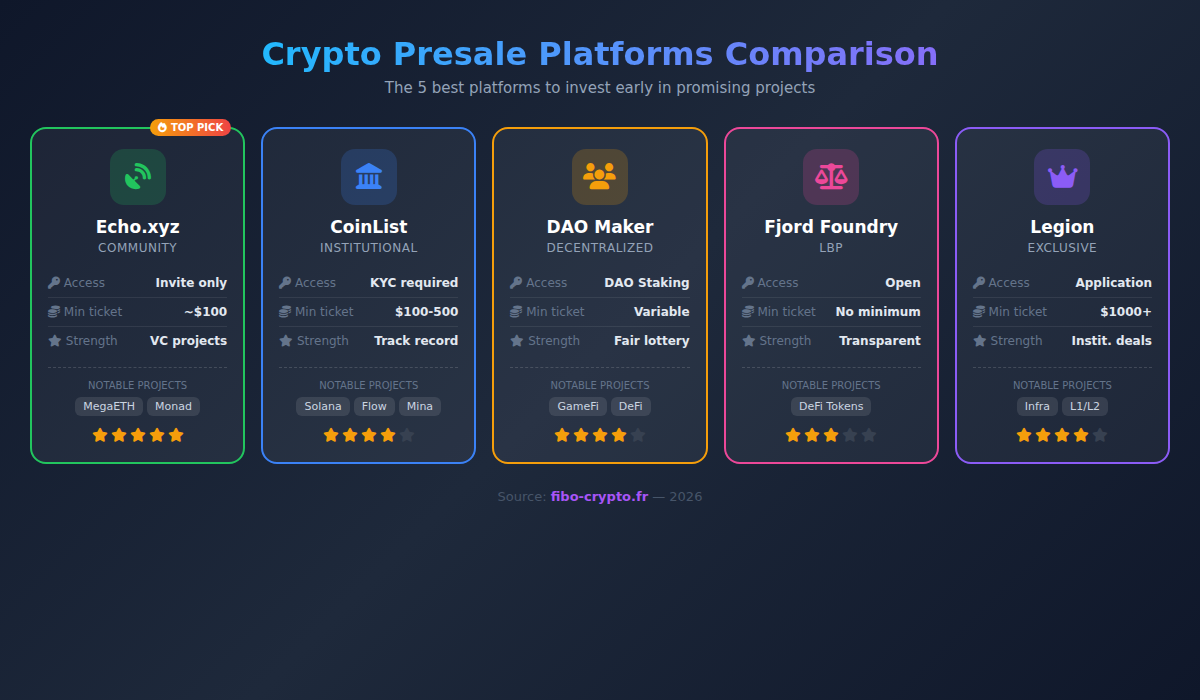
Comparison of Main Presale Platforms
| Platform | Type | Access | Min Ticket | Notable Projects | Strengths |
|---|---|---|---|---|---|
| Echo.xyz | Community | Invite / waitlist | ~$100 | MegaETH, Monad | Premium projects, active community |
| CoinList | Institutional | KYC required | $100-500 | Solana, Flow, Mina | Proven track record, regulated |
| DAO Maker | Decentralized | DAO Staking | Variable | GameFi, DeFi projects | Fair lottery system |
| Fjord Foundry | LBP | Open | No minimum | DeFi Tokens | Transparent price discovery |
| Legion | Exclusive | Application | $1000+ | Infra projects | Institutional deals |
Premium launchpads (VC-quality projects):
- Echo.xyz — Founded by Cobie, access to the same deals as Paradigm, Coinbase Ventures. This is where MegaETH did its community round.
- CoinList — Historically the most prestigious (Solana, Flow, Mina)
- Legion — Focus on infrastructure projects
Accessible launchpads:
- DAO Maker — Tier system based on staking
- Seedify — Focus on gaming and metaverse
- Polkastarter — Multi-chain ecosystem
- TrustSwap — Good track record, KYC required
2. Fundraising Trackers
When a project raises millions from reputable VCs, it’s a strong signal. These tools alert you to new rounds:
- Messari Fundraising — Database of +19,000 rounds, filterable by sector and investor
- Crunchbase — Traditional company data + crypto
- Crypto Fundraising (The Block) — Weekly newsletter of raises
- RootData — Focus on Asia and emerging projects
- ICO Drops — Calendar of upcoming ICO/IDO with ratings
Pro tip: filter by top-tier investors (Paradigm, a16z, Polychain, Coinbase Ventures). If these funds invest, the project has passed serious due diligence.
3. Developer Activity
A project with active code is a living project. The best projects are often spotted by their GitHub activity months before any token announcement.
- Electric Capital Developer Report — Annual report on dev activity by ecosystem
- GitHub directly — Recent commits, resolved issues, number of contributors
- ETHGlobal — Hackathon winners often become major projects
- Public grants — Optimism RetroPGF, Arbitrum Foundation, Gitcoin
4. Social Media and Communities
Alpha circulates in communities before reaching mainstream media.
- Twitter/X — Follow VCs (Cobie, Hsaka, Lookonchain), devs, and set up alerts for « seed round », « TGE« , « IDO »
- Protocol Discords — Join L1/L2 servers (Ethereum, Solana, Arbitrum) to see projects building there
- Telegram — Alpha groups (beware of scams)
- Reddit — r/CryptoCurrency, r/ethfinance for technical discussions
On-Chain Tools to Spot Weak Signals
Blockchain data is public. Pros use tools to analyze fund movements and detect interest before it becomes visible.
On-Chain Analysis Tools
- Nansen — Identifies « Smart Money » wallets and their movements (paid, ~$150/month)
- Arkham Intelligence — Entity attribution to wallets, VC and exchange tracking
- DeFiLlama — TVL by protocol, free and comprehensive
- Dune Analytics — Customizable dashboards, raw data
- Token Terminal — Financial metrics (revenue, fees) by protocol
New Token Discovery Tools
- DEX Screener — Newly listed tokens on DEXs, filters by chain and volume
- DEXTools — Trading pair analysis, trust score
- Token Sniffer — Fraudulent token detection (honeypots, rug pulls)
- CoinGecko / CoinMarketCap — « Recently Added » section
How to Evaluate an Early-Stage Project
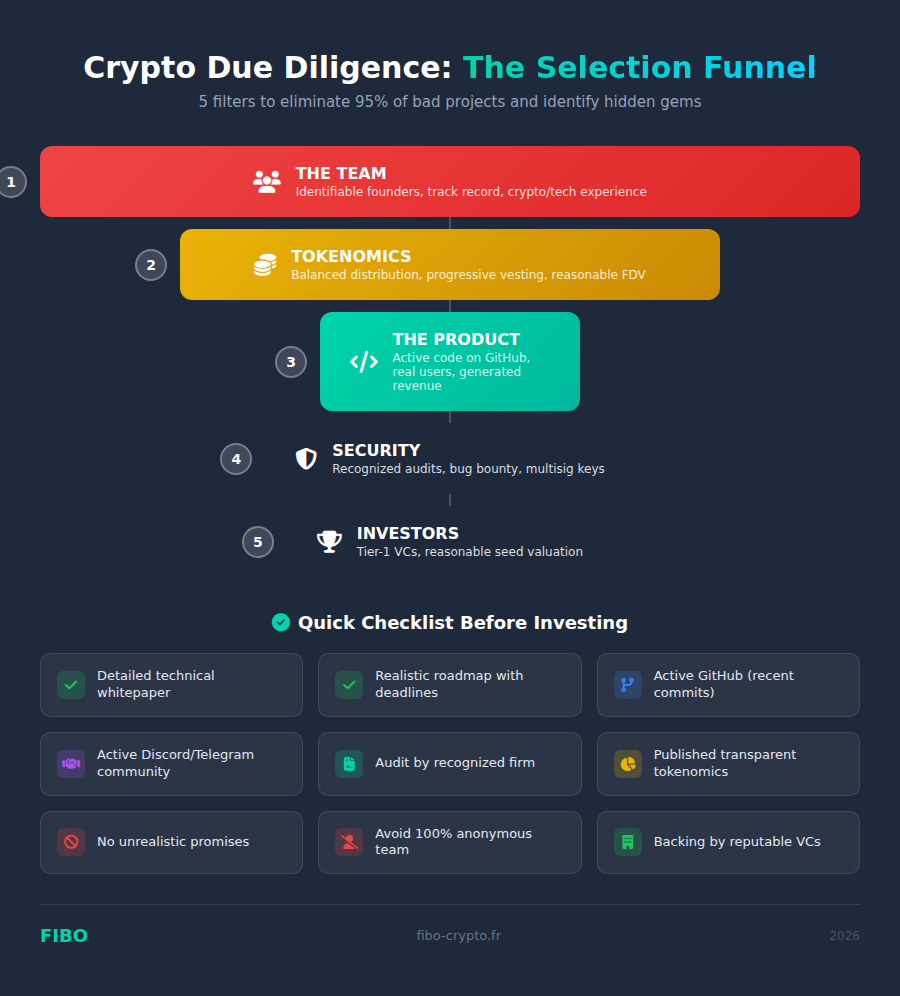
Finding a project early isn’t enough — you need to know how to evaluate it. Here are the 5 pillars of effective due diligence:
1. The Team
- Identifiable founders with verifiable track record?
- Experience in crypto or traditional tech?
- Anonymity without valid reason is a red flag
2. Tokenomics
- Circulating supply vs FDV (Fully Diluted Valuation) — watch out for tokens with only 5% in circulation
- Vesting schedule — massive unlocks kill prices
- Distribution — avoid if >30% in a single wallet
3. Real Usage
- Are there users paying for the service?
- Beware of TVL inflated by temporary incentives
- Look at fees generated and revenue retained by the protocol
4. Security
- Audits by recognized firms (Trail of Bits, OpenZeppelin, Certik)
- Active bug bounty program?
- Who controls admin keys and upgrades?
5. Investors
- Have tier-1 VCs invested? (signal of past due diligence)
- At what valuation? (compare with current valuation)
Concrete Strategies to Be Early
Strategy 1: Following Emerging Ecosystems
Identify new L1/L2s attracting developers and use their protocols before they announce a token. This is how early adopters of Arbitrum, Optimism, and zkSync received massive airdrops.
Strategy 2: Proactive Launchpad Registration
Don’t wait for a project to interest you before creating your account. Sign up now on Echo.xyz, CoinList, DAO Maker. Complete KYC. The best sales fill up in seconds.
Strategy 3: Testnets and Ambassador Programs
Participate in testnets of promising projects. It’s free (test tokens with no value) and often rewarded with airdrops at launch.
Strategy 4: Following « Utility » NFTs
Some projects launch NFTs (like MegaETH’s Fluffle) that give priority access to future token sales. Watch roadmaps that mention « utility token » or « governance token ».
Red Flags to Absolutely Avoid
90% of crypto projects fail or are scams. Here are the warning signs:
- Anonymous team without justification — Anonymity can be legitimate (protection), but requires more vigilance
- Guaranteed return promises — No return is guaranteed in crypto
- Hype without substance — Lots of marketing, little code or product
- Unbalanced tokenomics — Team with 40%+ of tokens, imminent massive unlocks
- Concentrated liquidity — Single pool, single exchange = easy manipulation
- Dead GitHub — No commits for months = abandoned project
- Copied whitepaper — Use plagiarism tools to verify
- FOMO pressure — « Last chance », « Only 24h left » = manipulation
📚 Glossaire
- Alpha : investment information or opportunity before it becomes known to the general public. « Alpha hunters » constantly seek these opportunities.
- Launchpad : platform organizing token sales (presales, IDO) before their public listing on exchanges. Examples: Echo.xyz, CoinList, DAO Maker.
- Presale : token sale at a reduced price before official launch, reserved for certain investors (via launchpad, whitelist, or specific conditions).
- TGE (Token Generation Event) : moment when tokens are created and distributed to private and public sale buyers. Marks the beginning of trading.
- FDV (Fully Diluted Valuation) : total project valuation if all planned tokens were in circulation. Compare with current market cap to evaluate future dilution.
- Vesting : progressive unlocking of tokens according to a predefined schedule. Protects against massive short-term dumping.
- DYOR (Do Your Own Research) : fundamental principle encouraging doing your own research before investing, without relying solely on influencers or marketing.
- Smart Money : institutional investors, VCs, and experienced whales whose on-chain movements are followed as trend indicators.
- TVL (Total Value Locked) : total value of assets deposited in a DeFi protocol. Indicator of trust and adoption, but can be artificially inflated.
- Tokenomics : economic structure of a token: total supply, distribution, inflation/deflation mechanisms, utility. Essential evaluation criterion.
- Whitepaper : technical document describing the project, its technology, economics, and roadmap. First document to read when evaluating a project.
- Roadmap : calendar of developments planned by the project. A realistic roadmap with met deadlines is a good signal.
Questions fréquentes
Do you need money to participate in presales?
Yes, presales generally require a minimum investment (often $100-1000). Some launchpads also require staking their native token to access better allocations. However, airdrops are free (just gas fees).
How to access Echo.xyz?
Create an account on echo.xyz, connect your wallet, and complete KYC. Access to deals often depends on your participation in certain groups or holding specific NFTs like « Lil Pudgys ».
Are free on-chain tools sufficient?
For beginners, yes. DeFiLlama, Dune Analytics, and Arkham (free version) offer tons of data. Paid tools (Nansen at ~$150/month) are useful for active traders who need real-time alerts on whale movements.
How to know if a project will do an airdrop?
Projects that don’t yet have a token, have raised significant funds, and mention « decentralized governance » in their roadmap are good candidates. Actively use the protocol and diversify your interactions (swaps, bridges, votes).
What is the main risk of early-stage investments?
Total loss of capital. Most crypto projects fail, are abandoned, or turn out to be scams. That’s why you must: diversify, only invest what you can lose, and apply rigorous due diligence.
How long does it take to find a good early project?
It’s ongoing work. The best « alpha hunters » spend several hours per week monitoring their sources, analyzing projects, and participating in communities. Patience and discipline are essential — expect 3-6 months before seeing results.
📰 Sources
Cet article s’appuie sur les sources suivantes :
Comment citer cet article : Fibo Crypto. (2026). How to Identify Crypto Projects Early: Complete Guide. Consulté le 9 février 2026 sur https://fibo-crypto.fr/en/blog/identify-crypto-projects-early-guide