
Crypto Asset vs Cryptocurrency vs Token vs Coin: All Differences Explained (2026)
📋 En bref (TL;DR)
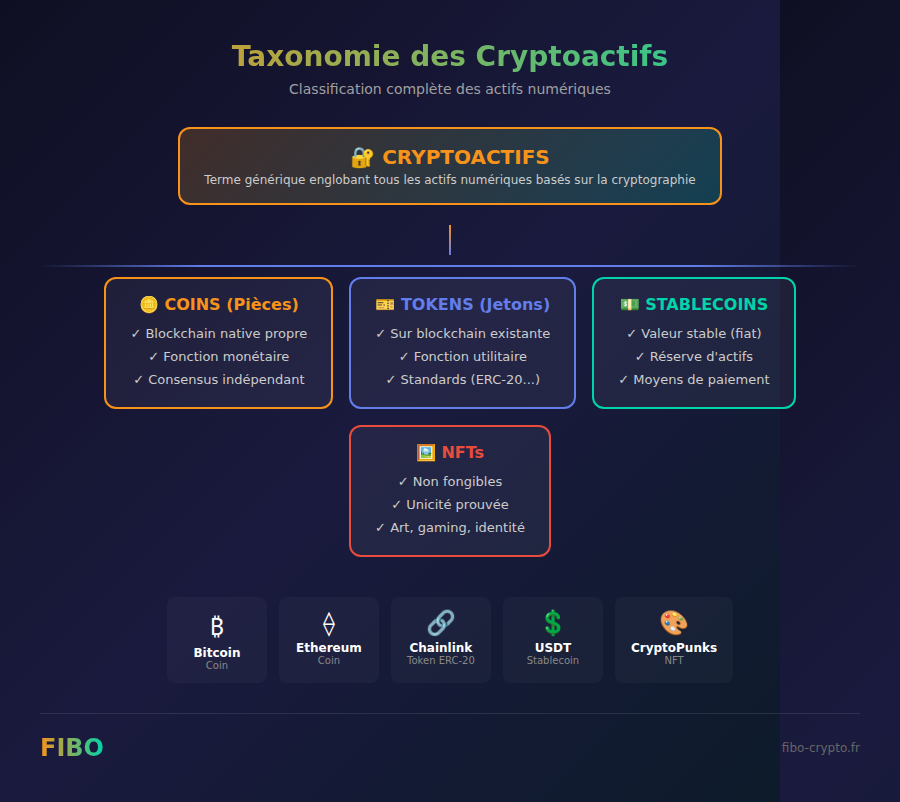
- Crypto asset = umbrella term: encompasses all digital assets based on cryptography (cryptocurrencies, tokens, stablecoins, NFTs)
- Cryptocurrency = monetary function: specifically refers to assets used as a medium of exchange or store of value (Bitcoin, Ethereum)
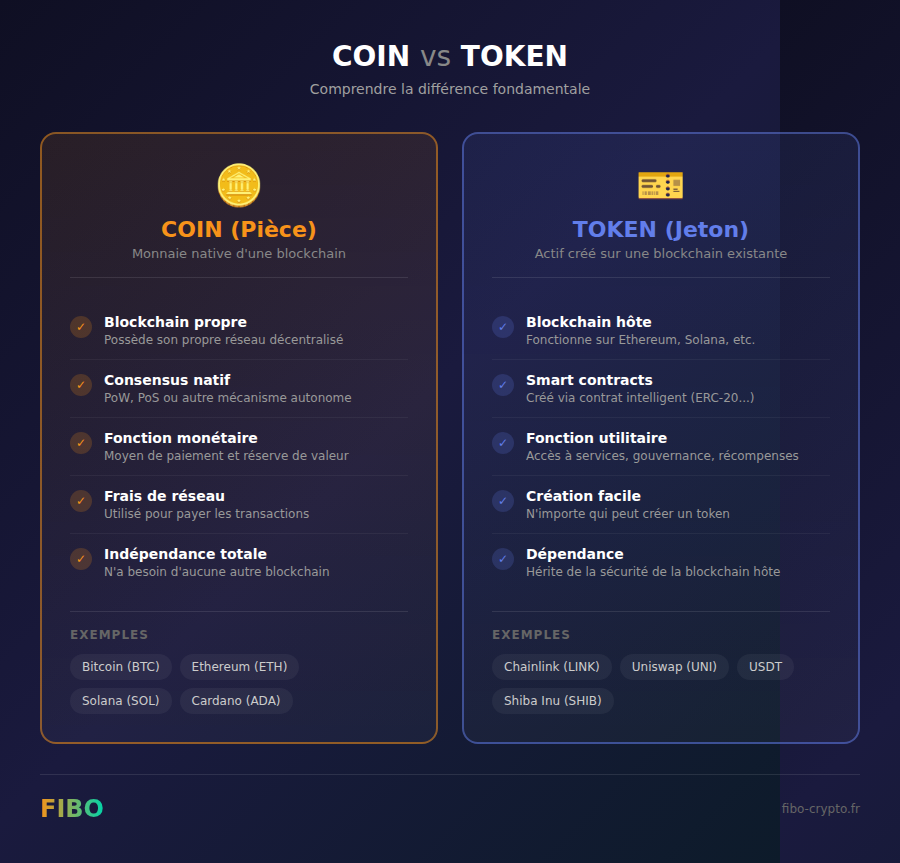
- Coin vs Token: a coin has its own native blockchain (BTC, ETH, SOL), while a token is created on an existing blockchain (LINK, UNI, SHIB)
- Stablecoins: crypto assets whose value is pegged to a fiat currency like the US dollar (USDT, USDC) or euro (EURC)
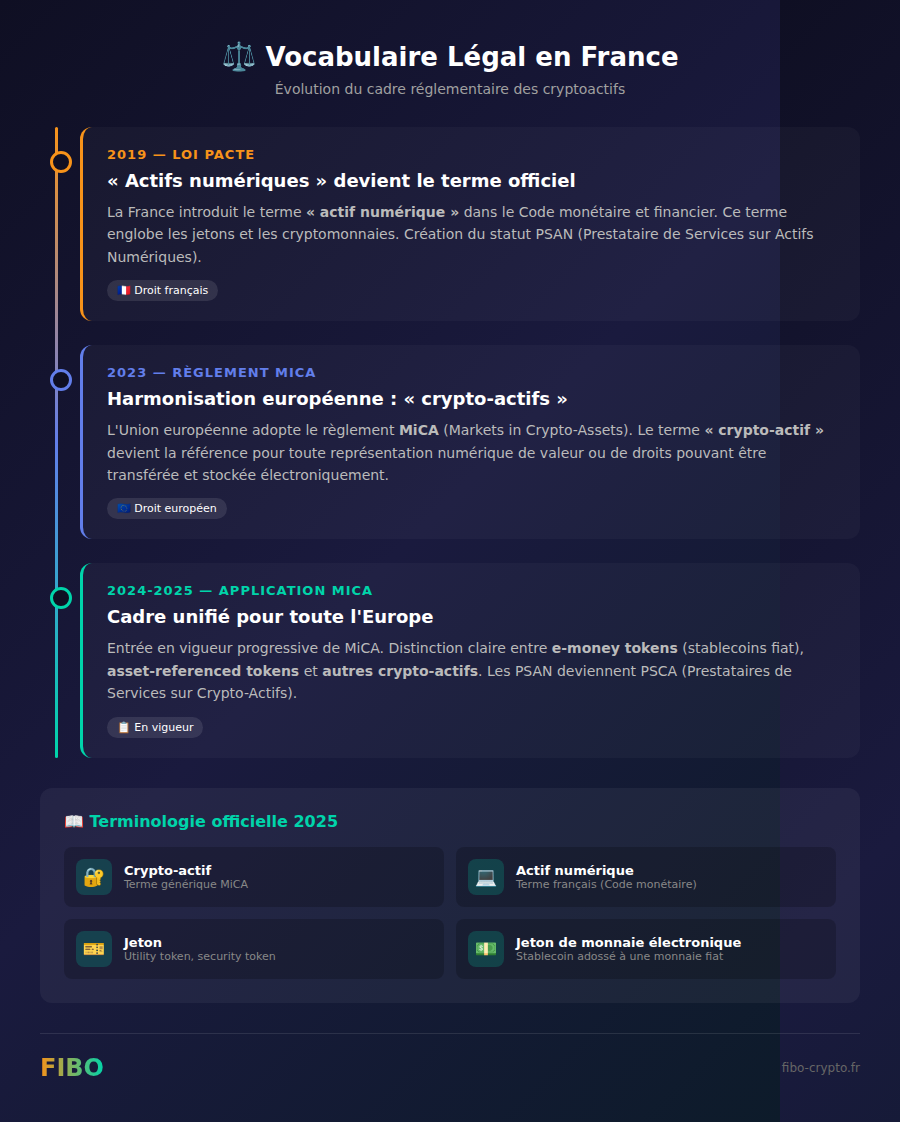
- Legal terminology varies: “crypto asset” is the EU term (MiCA regulation), while US regulators use various terms including “digital asset”
- In Europe since 2023: the MiCA regulation establishes “crypto-asset” as the harmonized term across the European Union
- For investors: understanding these distinctions helps better evaluate risks and opportunities of each crypto asset type
Cryptocurrency, crypto asset, digital token, coin — these terms are used in media and conversations, often interchangeably. Yet they cover distinct technical and legal realities. This confusion is particularly problematic as the terminology chosen has legal, tax, and practical implications for every investor.
In 2026, the crypto asset market represents over $3 trillion in market capitalization, with more than 25,000 cryptocurrencies listed. Faced with this diversity, precisely understanding what each term means isn’t an intellectual luxury: it’s a necessity for smart investing and regulatory compliance.
In this comprehensive guide, we’ll demystify each term, explore their technical and legal differences, and give you the keys to navigate this ecosystem with confidence.
What is a Crypto Asset? Complete Definition
A crypto asset is the broadest category. According to the European Union’s MiCA regulation, it’s defined as “a digital representation of a value or a right which may be transferred and stored electronically, using distributed ledger technology or similar technology.”
This definition encompasses all assets that:
- Are stored and transferred electronically
- Use cryptography to secure transactions
- Generally operate on a blockchain or distributed ledger
- Enable peer-to-peer exchanges without centralized intermediaries
Concretely, the term “crypto asset” covers:
- Cryptocurrencies (Bitcoin, Litecoin, Monero)
- Utility tokens (Chainlink, Basic Attention Token)
- Stablecoins (USDT, USDC, DAI)
- NFTs (Non-Fungible Tokens)
- Security tokens (tokens representing financial assets)
The term “crypto asset” is therefore the most encompassing and technically neutral. This is why regulators have adopted it to designate this emerging asset class as a whole.
Cryptocurrency: Definition and Characteristics
A cryptocurrency is a specific type of crypto asset designed to function as a medium of exchange. The term emphasizes the monetary function of the asset.
To be considered a cryptocurrency in the strict sense, an asset must fulfill the traditional functions of money:
- Medium of exchange: enables buying goods and services
- Unit of account: serves to express the value of things
- Store of value: maintains purchasing power over time
Bitcoin is the emblematic example of a cryptocurrency: created in 2009 by Satoshi Nakamoto, it was designed from the start as a “peer-to-peer electronic cash system.” Its supply limited to 21 million units also makes it a potential store of value, often compared to digital gold.
However, in common usage, the term “cryptocurrency” is often used extensively to refer to all crypto assets, which creates confusion. Technically, a governance token like UNI (Uniswap) isn’t a “currency” in the economic sense, even though it’s frequently called one.
Difference Between Crypto Asset and Cryptocurrency
The distinction is simple:
- Crypto asset = general category (hypernym)
- Cryptocurrency = subcategory with monetary function (hyponym)
All cryptocurrencies are crypto assets, but not all crypto assets are cryptocurrencies. An NFT representing a piece of art is a crypto asset, but not a cryptocurrency.
Coin vs Token: The Fundamental Technical Distinction
Beyond general vocabulary, a crucial technical distinction separates coins from tokens. This difference is often misunderstood, even by experienced investors.
What is a Coin?
A coin is a unit of value native to a blockchain. It was born with that blockchain and constitutes its main currency, essential to its operation.
Characteristics of a coin:
- Has its own independent blockchain
- Used to pay network transaction fees
- Used to reward validators (miners or stakers)
- Operates with its own consensus mechanism
- Doesn’t need any other blockchain to exist
Examples of coins:
- Bitcoin (BTC): native coin of the Bitcoin blockchain
- Ether (ETH): native coin of the Ethereum blockchain
- Solana (SOL): native coin of the Solana blockchain
- Cardano (ADA): native coin of the Cardano blockchain
- BNB: native coin of BNB Chain (formerly Binance Smart Chain)
What is a Token?
A token is an asset created on an existing blockchain via a smart contract. It “borrows” another blockchain’s infrastructure to exist.
Characteristics of a token:
- Created on a host blockchain (Ethereum, Solana, etc.)
- Functions through a smart contract
- Follows a technical standard (ERC-20, ERC-721, SPL, etc.)
- Depends on the host blockchain’s security
- Can be created by anyone with technical skills
Examples of tokens:
- Chainlink (LINK): ERC-20 token on Ethereum
- Uniswap (UNI): ERC-20 governance token
- Shiba Inu (SHIB): ERC-20 memecoin
- USDT (Tether): stablecoin existing on multiple blockchains
- Axie Infinity (AXS): gaming token
Why This Distinction Matters
Understanding whether an asset is a coin or token helps you:
- Evaluate security: a token depends on its host blockchain
- Understand fees: to transfer an ERC-20 token, you pay in ETH
- Identify risks: creating a token is easy, hence the proliferation of scams
- Analyze the project: a coin implies greater technological ambition
Different Types of Tokens
Not all tokens are alike. Several categories are distinguished based on their primary function.
Utility Tokens
Utility tokens provide access to a service or functionality within an ecosystem. They’re not intended as investments but as “access keys.”
Examples:
- Basic Attention Token (BAT): used in Brave browser to reward attention
- Filecoin (FIL): payment for decentralized storage
- Chainlink (LINK): payment for decentralized oracle services
Governance Tokens
Governance tokens give holders voting power over the evolution of a decentralized protocol (DAO).
Examples:
- Uniswap (UNI): voting on Uniswap DEX parameters
- Aave (AAVE): governance of the lending protocol
- Maker (MKR): governance of MakerDAO and the DAI stablecoin
Security Tokens
Security tokens represent rights to a traditional financial asset (stock, bond, real estate). They’re subject to financial market regulations.
Examples:
- Tokenized company shares
- Tokenized real estate fund shares
- Government bonds on blockchain
Memecoins
Memecoins are tokens created around a meme or cultural trend. Their value is essentially based on community and speculation.
Examples:
- Dogecoin (DOGE): the original memecoin (technically a coin)
- Shiba Inu (SHIB): ERC-20 memecoin
- Pepe (PEPE): memecoin based on Pepe the Frog meme
Stablecoins: Stable-Value Crypto Assets
Stablecoins form a particular category of crypto assets whose value is designed to remain stable, usually pegged to a fiat currency (dollar, euro) or a basket of assets.
Types of Stablecoins
1. Fiat-backed stablecoins (collateralized)
Each token issued is backed by an equivalent fiat deposit in a bank account.
- USDT (Tether): ~$110 billion market cap
- USDC (Circle): ~$35 billion, regular audits
- EURC: stablecoin pegged to the euro
2. Algorithmic stablecoins
Stability is maintained through market mechanisms and algorithms, without equivalent physical reserves.
- DAI: crypto-overcollateralized, managed by MakerDAO
- FRAX: partially algorithmic
3. Commodity-backed stablecoins
- Tether Gold (XAUT): pegged to physical gold
- PAX Gold (PAXG): each token = 1 ounce of stored gold
Stablecoin-Specific Risks
- De-peg risk: loss of the peg (cf. UST in 2022)
- Counterparty risk: quality of issuer’s reserves
- Regulatory risk: subject to MiCA in Europe
NFTs: Non-Fungible Tokens
NFTs (Non-Fungible Tokens) are unique and non-interchangeable tokens. Unlike a bitcoin which is identical to another bitcoin, each NFT is distinct.
NFT Characteristics
- Uniqueness: each NFT has a unique identifier
- Indivisibility: you can’t own 0.5 NFT (generally)
- Verifiable ownership: history is recorded on the blockchain
- Interoperability: transferable between compatible platforms
NFT Use Cases
- Digital art: certified works (Beeple, CryptoPunks)
- Gaming: in-game items, characters
- Music: rights, collector editions
- Virtual real estate: land in metaverses
- Identity: diplomas, certificates, event tickets
Legal Terminology in the US and Europe
Terms used by regulators have legal and tax importance. Understanding official vocabulary is essential for any investor.
In the United States: Various Terms
The US regulatory landscape uses different terms depending on the agency:
- SEC: often refers to many tokens as “securities” or “crypto asset securities”
- CFTC: treats Bitcoin and Ethereum as “commodities”
- FinCEN: uses “convertible virtual currency” (CVC)
- IRS: classifies crypto as “property” for tax purposes
This fragmented approach creates regulatory uncertainty, with ongoing debates about which assets are securities versus commodities.
In Europe: “Crypto-Asset” Under MiCA (Since 2023)
The European MiCA (Markets in Crypto-Assets) regulation, adopted in 2023 and fully applicable since late 2024, harmonizes terminology at the European level.
MiCA defines three categories of crypto-assets:
- E-money tokens: stablecoins backed by a single fiat currency
- Asset-referenced tokens: stablecoins backed by multiple assets
- Other crypto-assets: everything else (Bitcoin, Ethereum, utility tokens…)
Service providers must obtain a CASP (Crypto-Asset Service Provider) license to operate across the EU.
Tax Implications
Tax treatment varies by jurisdiction. In the US, crypto is treated as property, meaning each trade is a taxable event subject to capital gains tax. In the EU, member states have varying approaches, though MiCA aims to bring more harmonization over time.
Summary Table of Terms
Here’s a summary of the different terms and their meanings:
| Term | Definition | Examples |
|---|---|---|
| Crypto asset | Generic term for any cryptographic digital asset | Bitcoin, USDT, NFT, tokens |
| Cryptocurrency | Crypto asset with monetary function | Bitcoin, Litecoin, Monero |
| Coin | Native unit of its own blockchain | BTC, ETH, SOL, ADA |
| Token | Asset created on an existing blockchain | LINK, UNI, SHIB, USDT |
| Stablecoin | Stable-value crypto asset | USDT, USDC, DAI |
| NFT | Unique, non-fungible token | CryptoPunks, Bored Apes |
| Digital asset | Broad term used by US regulators | — |
| Crypto-asset | EU legal term (MiCA) | — |
How to Invest Based on Crypto Asset Type
Each crypto asset category presents different risk and return characteristics.
Layer 1 Coins (BTC, ETH, SOL)
- Profile: long-term conviction investment
- Risk: significant volatility but established projects
- Usage: portfolio core (60-80%)
Utility and Governance Tokens
- Profile: exposure to specific sectors (DeFi, oracles…)
- Risk: dependent on project success
- Usage: diversification (10-30%)
Stablecoins
- Profile: capital preservation, DeFi yield
- Risk: counterparty, regulatory risk
- Usage: liquidity, waiting for opportunities
Memecoins and Speculative Tokens
- Profile: pure speculation, community effect
- Risk: very high, possibility of total loss
- Usage: maximum 5% of portfolio, “fun money”

📚 Glossary
- Crypto asset : Generic term for any digital asset using cryptography, stored on a blockchain or distributed ledger.
- Cryptocurrency : Subcategory of crypto asset designed to serve as medium of exchange, unit of account, and store of value.
- Coin : Native unit of value of an independent blockchain, essential to its operation (e.g., Bitcoin, Ether).
- Token : Digital asset created on an existing blockchain via a smart contract, following a technical standard (e.g., ERC-20).
- Stablecoin : Crypto asset whose value is designed to remain stable, usually pegged to a fiat currency or basket of assets.
- NFT (Non-Fungible Token) : Unique, non-interchangeable token representing ownership of a digital or physical asset.
- Blockchain : Distributed ledger technology where transactions are grouped into cryptographically chained blocks.
- Smart contract : Autonomous program executed on a blockchain, defining the rules of a token or decentralized application.
- ERC-20 : Technical standard for creating fungible tokens on the Ethereum blockchain.
- MiCA : European regulation (Markets in Crypto-Assets) harmonizing crypto-asset regulation across the European Union.
- CASP : Crypto-Asset Service Provider, entity licensed under MiCA to provide crypto services in the EU.
- De-peg : Loss of a stablecoin’s anchor to its target value (e.g., 1 USDT becoming less than 1 USD).
- Fungibility : Property of an asset being interchangeable with another identical asset (1 BTC = 1 BTC).
- Layer 1 : Base blockchain on which applications and tokens function (Ethereum, Solana, Bitcoin).
- Digital asset : Broad term used by US regulators to describe crypto and other electronic representations of value.
Frequently Asked Questions
What is the difference between a cryptocurrency and a crypto asset?
A crypto asset is the generic term encompassing all digital assets based on cryptography: cryptocurrencies, tokens, stablecoins, NFTs. A cryptocurrency is a specific subcategory of crypto asset designed to serve as a medium of exchange and store of value, like Bitcoin or Litecoin. All cryptocurrencies are crypto assets, but not all crypto assets are cryptocurrencies. For example, an NFT representing a piece of art is a crypto asset, but not a cryptocurrency.
What is a token in crypto?
A token is a digital asset created on an existing blockchain via a smart contract. Unlike coins that have their own blockchain (like Bitcoin or Ethereum), tokens use another blockchain’s infrastructure to function. For example, Chainlink’s LINK token is an ERC-20 token created on Ethereum. Tokens can have different functions: utility (access to a service), governance (voting rights), or representing assets (stablecoins, security tokens).
What is the difference between a coin and a token?
The fundamental difference is technical: a coin has its own native, independent blockchain (Bitcoin, Ethereum, Solana), while a token is created on an existing blockchain via a smart contract (LINK, UNI, SHIB on Ethereum). A coin typically serves to pay its network’s transaction fees and reward validators. A token depends on its host blockchain’s security and operation. To transfer an ERC-20 token, you must pay fees in ETH, Ethereum’s native coin.
Is cryptocurrency legal?
Yes, cryptocurrency is legal in most developed countries including the US and EU. In the US, it’s regulated by various agencies (SEC, CFTC, FinCEN) with crypto treated as property for tax purposes. In Europe, the MiCA regulation provides a harmonized framework since 2024. Service providers must be registered or licensed. Gains are taxable. Investment is legal but not government-guaranteed. Regulations vary by country, so check your local laws.
What is a stablecoin and what is it used for?
A stablecoin is a crypto asset designed to maintain a stable value, usually pegged to a fiat currency like the dollar (USDT, USDC) or euro (EURC). Stablecoins are used to: reduce volatility in a crypto portfolio, facilitate exchanges between cryptos without converting to fiat, generate DeFi yields, and make fast international payments. Caution: despite their name, they carry risks (de-peg, counterparty, regulatory) as shown by UST’s collapse in 2022.
Is Bitcoin a coin or a token?
Bitcoin (BTC) is a coin, not a token. It’s the native unit of the Bitcoin blockchain, created along with the network in 2009. Bitcoin has its own independent blockchain with its consensus mechanism (Proof of Work) and doesn’t need any other infrastructure to function. It’s the original cryptocurrency and the largest by market cap. However, “wrapped” versions of Bitcoin on other blockchains (like WBTC on Ethereum) are tokens representing Bitcoin.
What is the MiCA regulation?
MiCA (Markets in Crypto-Assets) is the European regulation adopted in 2023 that harmonizes crypto-asset regulation across the European Union. It defines three categories of crypto-assets (e-money tokens, asset-referenced tokens, others), imposes rules on stablecoin issuers, and creates a European passport for crypto service providers (CASPs). MiCA aims to protect investors while fostering innovation. It has been fully applicable since late 2024.
How are crypto assets taxed?
Crypto tax treatment varies by jurisdiction. In the US, crypto is treated as property by the IRS, meaning each sale or trade is a taxable event subject to capital gains tax (short-term or long-term depending on holding period). In the EU, rules vary by member state but generally capital gains are taxed. Key taxable events include: selling for fiat, trading one crypto for another, using crypto to buy goods/services. Consult a tax professional for your specific situation.
📰 Sources
This article is based on the following sources:
- EUR-Lex – MiCA Regulation
- SEC – Framework for “Investment Contract” Analysis
- IRS – Virtual Currencies
- CoinMarketCap – Glossary
- Ethereum.org – Token Standards
- CFTC – Digital Assets
Comment citer cet article : Fibo Crypto. (2026). Crypto Asset vs Cryptocurrency vs Token vs Coin: All Differences Explained (2026). Consulté le 27 February 2026 sur https://fibo-crypto.fr/en/blog/crypto-asset-cryptocurrency-token-coin-difference