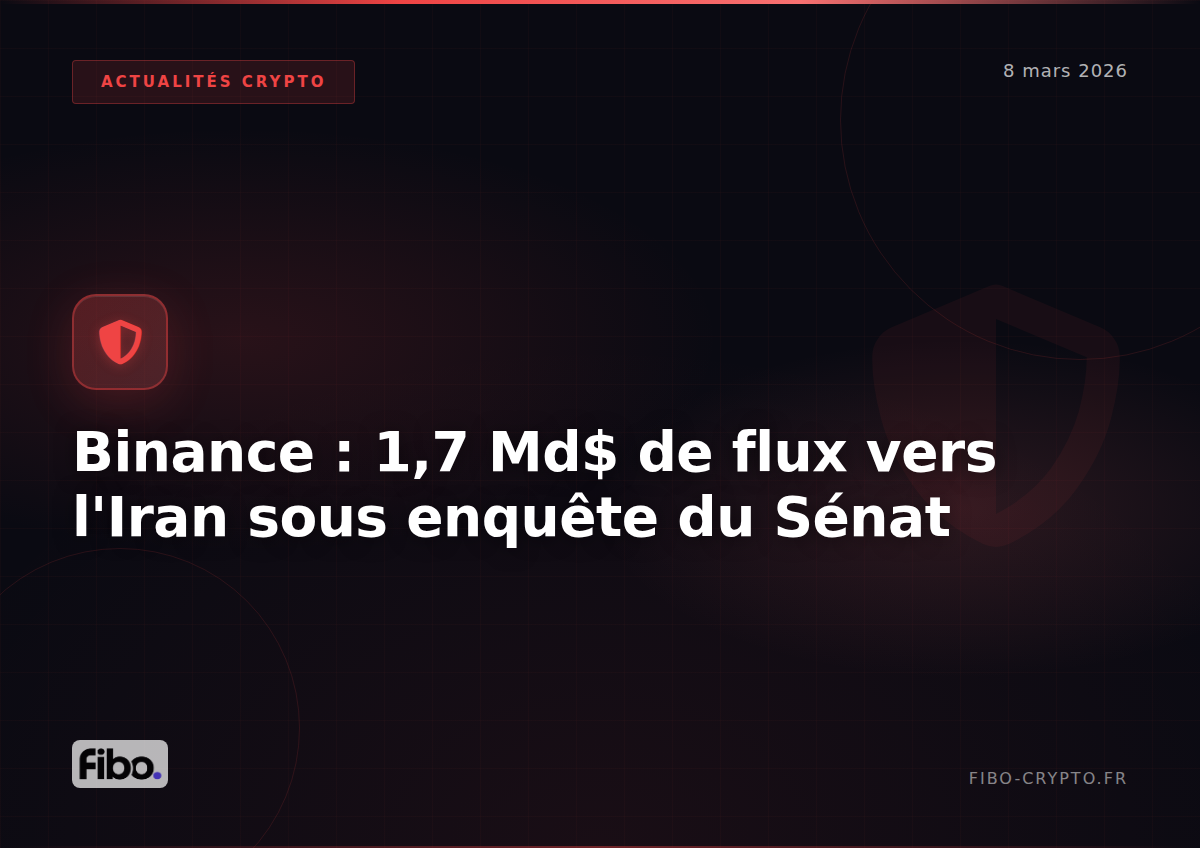
Binance Accused of $1.7 Billion in Flows to Iran: US Senate Investigates
📋 En bref (TL;DR)
- Senate investigation: Senator Richard Blumenthal and 11 Democratic colleagues launched a formal investigation in late February 2026 into Binance and its alleged ties to Iran.
- $1.7 billion: According to the Wall Street Journal and the New York Times, Binance’s internal investigators reportedly identified this amount flowing to Iran-linked entities.
- Islamic Revolutionary Guard Corps: Some funds allegedly reached crypto wallets associated with the Islamic Revolutionary Guard Corps (IRGC), designated as a terrorist organization by the United States.
- Binance’s response: On March 6, 2026, the platform rejected the accusations, cited “indirect exposure,” and called the allegations “patently false and defamatory.”
- Aggravating context: Binance had already pleaded guilty in 2023 to violations of anti-money laundering rules and sanctions regulations, leading to the departure of its founder CZ.
- Rising crypto crime: Chainalysis reports a record $154 billion in crypto crime in 2025, driven by a 694% surge in state sanctions evasion.
The world’s largest crypto exchange is once again in the crosshairs of US authorities. In late February 2026, twelve Democratic senators opened a formal investigation into Binance, suspected of allowing $1.7 billion to flow to Iran-linked entities. The case revives the ghosts of an already heavy judicial past for the world’s top crypto exchange.
An explosive Senate investigation
Senator Richard Blumenthal of Connecticut led the charge. Joined by eleven Democratic colleagues, he sent a formal letter to Binance in late February 2026 demanding explanations for alleged financial flows to Iran, a country under strict US sanctions for decades.
The move followed revelations from the Wall Street Journal and the New York Times, which reported that Binance’s own internal investigators had identified these suspicious fund movements. According to those outlets, compliance analysts at the platform had discovered that more than 1,500 accounts had been opened and used from Iranian territory, in direct violation of international sanctions.
More seriously, some of those funds allegedly flowed to digital wallets associated with the Islamic Revolutionary Guard Corps (IRGC), Iran’s elite military force designated as a terrorist organization by Washington. For the senators who signed the letter, this is no longer a matter of simple regulatory negligence, but potentially complicity with actors threatening US national security.
Binance’s response: between denial and nuance
Facing this political and media pressure, Binance broke its silence on March 6, 2026 with an official statement. The platform categorically denies any direct flows to Iran and refutes the accusations in particularly forceful terms, calling them “patently false and defamatory.”
The company does, however, acknowledge “indirect exposure” — a legally significant term suggesting that transactions did pass through its platform without Binance being the direct initiator. The distinction is subtle but crucial: under US sanctions law, even indirect exposure can constitute a violation if the platform was aware of the pattern or failed to implement sufficient controls.
Binance also states that it removed the accounts in question upon detection and cooperated with law enforcement. An argument that, if accurate, could mitigate its legal liability — but it does not resolve the core question: how did 1,500 Iranian accounts manage to operate on the platform, and for how long?
The platform did not clarify whether these account removals occurred before or after the journalistic and senatorial investigations — a timeline that will be decisive in establishing good faith.

A judicial past that weighs heavily
This case does not arise in a vacuum. In November 2023, Binance reached a landmark agreement with the US Department of Justice: the platform pleaded guilty to charges of violating anti-money laundering laws and sanctions regulations, and agreed to pay a record fine of $4.3 billion. Its founder, Changpeng Zhao — known as “CZ” — was required to resign as part of the agreement and was himself sentenced to four months in prison.
The 2023 agreement imposed enhanced oversight on Binance through an independent compliance monitor for five years. The new revelations about Iranian flows therefore raise a direct question: did these alleged violations occur before or after this monitoring mechanism was put in place? In the latter case, the legal consequences could be far more severe.
In parallel, an unexpected development has added nuance to the picture. A US judge recently cleared CZ of terrorism financing charges brought in a separate civil proceeding. This decision does not prejudge the outcome of the current Senate investigation, but it illustrates the complexity of cases involving crypto platform executives.
For investors who use Binance or hold cryptocurrencies through the platform, these repeated legal turbulences raise a fundamental question: how much regulatory pressure can the platform absorb before it affects its operational stability?
The broader context: crypto in the service of sanctions evasion
The Binance-Iran case fits into an alarming trend documented by Chainalysis, one of the leading blockchain analytics firms. According to its annual report published in early 2026, crypto crime reached a record $154 billion in 2025.
The figure drawing the most regulatory attention: a 694% increase in transactions linked to state-sponsored sanctions evasion. Iran, Russia, and North Korea are regularly cited among the countries exploiting gaps in decentralized finance to circumvent international economic restrictions.
This context explains why US senators are scrutinizing the Binance case with particular intensity. For them, allowing — even inadvertently — Iranian entities linked to the IRGC to use a platform to move funds amounts to undermining a key pillar of US foreign policy: economic pressure on Tehran.
The sanctions question is all the more sensitive because public blockchains offer theoretically complete traceability. Analytics tools like those provided by Chainalysis can now trace flows with growing precision. If the Iranian transactions could be identified, it is precisely because the blockchain maintains a permanent record. The real issue, therefore, is not detection — it is upstream prevention by the platforms.
What does this mean for users and the sector?
For Binance users, the Senate investigation does not signal an immediate danger to their funds. The 2023 precedent showed that the platform can survive massive fines and continue operating. However, several risks are worth considering.
First, the regulatory risk: if the investigation results in additional sanctions or a challenge to the 2023 agreement, Binance could face restrictions on access to US markets. The United States represents a reservoir of clients and liquidity that no major player in the sector can afford to ignore indefinitely.
Second, the systemic risk: Binance accounts for a very large share of global cryptocurrency trading volume. Any major disruption to its operations would have cascading effects on prices and liquidity across the global market.
For the crypto sector as a whole, this case intensifies pressure for more rigorous KYC and AML standards. US, European, and UK regulators are converging on the view that an exchange must be able to demonstrate — in real time, not after the fact — that its systems effectively prevent transactions toward sanctioned jurisdictions.
The challenge for the entire industry is to show that crypto can be a responsible financial technology, not a vehicle for circumventing international law. Every scandal of this kind delays institutional adoption and gives ammunition to those who advocate stricter regulation.
📚 Glossary
- Exchange (crypto exchange)
- A website or application that allows users to buy, sell, and trade cryptocurrencies for other digital currencies or traditional currencies such as the euro or dollar. Binance is the largest exchange in the world by volume.
- Iran sanctions
- A set of economic and financial measures imposed by the United States, the European Union, and other countries on Iran to pressure the regime into changing certain behaviors, particularly its nuclear program. Financial transactions with Iran are largely prohibited for companies operating under US jurisdiction.
- Digital wallet (wallet)
- Software or a physical device used to store, send, and receive cryptocurrencies. A wallet address is public and visible on the blockchain, allowing analysts to trace fund flows.
- AML (Anti-Money Laundering)
- The set of rules and procedures designed to prevent money laundering. Regulated crypto platforms are required to implement transaction monitoring systems and report suspicious activities to authorities.
- Blockchain
- A decentralized, immutable digital ledger that records all crypto transactions transparently. Every transaction is publicly visible, enabling firms like Chainalysis to trace fund flows even years after the fact.
- KYC (Know Your Customer)
- A mandatory identity verification process imposed on regulated financial platforms. Its purpose is to ensure that customers are not criminals, sanctioned individuals, or residents of prohibited countries.
- Cryptocurrency
- A digital asset that uses cryptography to secure transactions and operates on a decentralized blockchain-type network, without a central authority such as a central bank.
- IRGC (Islamic Revolutionary Guard Corps)
- An elite branch of the Iranian armed forces, designated as a Foreign Terrorist Organization by the United States since 2019. Any financial support, direct or indirect, to the IRGC is illegal under US law.
Frequently asked questions
Did Binance really send $1.7 billion to Iran?
This figure comes from reports by Binance’s own internal investigators, as cited by the Wall Street Journal and the New York Times. Binance denies any direct flows, admitting only to “indirect exposure.” The Senate investigation aims precisely to establish the facts with precision.
What is the Islamic Revolutionary Guard Corps (IRGC) and why does this matter?
The IRGC is an elite Iranian military force designated as a terrorist organization by the United States since 2019. Any financial support to this entity, even indirect, constitutes a serious violation of US law and can result in severe criminal penalties.
Are my funds on Binance at risk because of this investigation?
At this stage, there is no immediate danger to user funds. Binance survived the $4.3 billion fine in 2023 and continues to operate normally. However, a regulatory escalation or restriction of access to US markets could, over time, affect the platform’s liquidity.
Why are cryptocurrencies used to evade sanctions?
Cryptocurrencies enable fast cross-border transfers without going through the traditional banking system, which is closely monitored. Countries like Iran, Russia, and North Korea exploit this feature to evade economic sanctions. In 2025, this type of evasion increased by 694% according to Chainalysis.
What could the consequences be for Binance if the accusations are confirmed?
Consequences could include new massive fines, revocation or restriction of operating licenses in the United States, tightened oversight imposed by the compliance monitor, and potentially criminal charges against executives. Binance has already been under the supervision of an independent monitor since its 2023 agreement.
📰 Sources
This article is based on the following sources:
- Wall Street Journal — Report on flows to Iran identified by Binance’s internal investigators, February 2026
- New York Times — Investigation into the 1,500 Iranian accounts and links to the IRGC, February 2026
- Chainalysis — 2025 Crypto Crime Report: $154 billion in illicit transactions, 694% increase in state sanctions evasion
- US Department of Justice — Binance guilty plea agreement, November 2023, $4.3 billion fine