
Crypto Bear Market: Understanding Cycles and the Current Context

📋 En bref (TL;DR)
- Definition: A crypto bear market is characterized by a drop of more than 20% from highs, widespread negative sentiment, and a prolonged duration (months to years)
- Historical cycle: Bitcoin has experienced bear markets after each halving — 2014-2015 (-85%), 2018-2019 (-84%), 2022 (-77%) — but past patterns don’t guarantee the future
- 2025-2026 context: Trade tariffs, high Fed rates, geopolitical tensions weigh on risk assets, but institutional ETFs are changing market structure
- Why it’s different: Massive institutional adoption (BlackRock, Fidelity) and state strategic reserves potentially alter cyclical dynamics
- Recommended strategy: Don’t panic, maintain long-term positions, consider DCA to accumulate gradually
- Key takeaway: Bear markets are normal phases of economic cycles — historically, every crypto bear market has been followed by a new all-time high
For several weeks, the crypto market has shown significant declines. Bitcoin has lost nearly 30% from its all-time high of $108,000, dragging the entire market down with it. The terms « bear market » and « crypto winter » are back in every conversation. But have we really entered a prolonged bearish market, or is this a correction within a bullish trend?
To answer this question, we need to understand what a bear market really is, analyze the history of crypto cycles, and most importantly put the current market in its economic and geopolitical context.
What is a bear market?
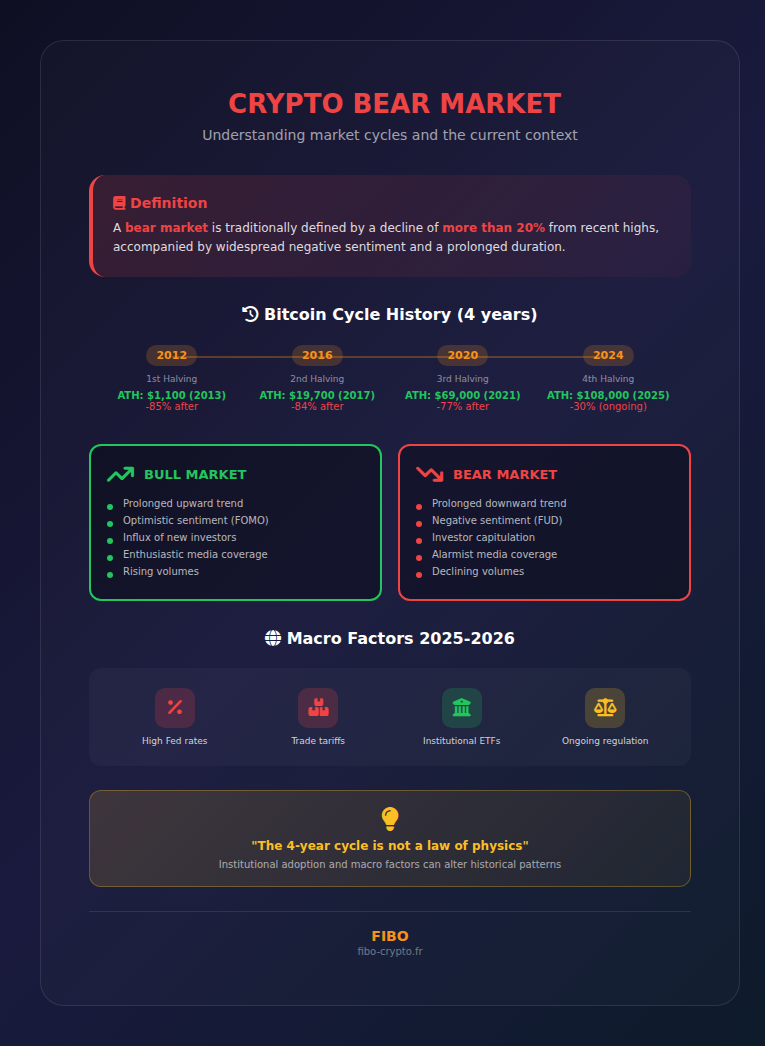
A bear market is traditionally defined by a decline of more than 20% from recent highs, accompanied by widespread negative sentiment and a prolonged duration of several months. In the crypto context, this classic financial market definition applies, but with much higher volatility.
The term « bear » comes from the way a bear attacks: by swiping downward with its claws. Conversely, a « bull » attacks upward with its horns.
Characteristics of a crypto bear market
- Prolonged price decline: More than 50-80% from ATH for Bitcoin, often more for altcoins
- Dominant negative sentiment: Widespread FUD (Fear, Uncertainty, Doubt)
- Investor capitulation: Panic selling, particularly from retail
- Declining volumes: Less activity on exchanges
- Negative media: « Bitcoin is dead » announcements in mainstream press
- Bankruptcies and scandals: Weak projects collapse (FTX, Luna, Celsius…)
The 4-year cycle myth
The « 4-year cycle » is a popular theory that Bitcoin follows a predictable pattern tied to halvings, with a bull market 12-18 months after each halving, followed by a bear market. This theory has proven true during the first three cycles, but it’s not a law of physics.
Bitcoin cycle history
Cycle 1 (2012-2015)
- Halving: November 2012
- ATH: $1,100 (December 2013)
- Bear market: -85% to $170 (January 2015)
- Bear duration: ~14 months
Cycle 2 (2016-2018)
- Halving: July 2016
- ATH: $19,700 (December 2017)
- Bear market: -84% to $3,200 (December 2018)
- Bear duration: ~12 months
Cycle 3 (2020-2022)
- Halving: May 2020
- ATH: $69,000 (November 2021)
- Bear market: -77% to $15,500 (November 2022)
- Bear duration: ~12 months
Cycle 4 (2024-?)
- Halving: April 2024
- ATH: $108,000 (January 2025)
- Current correction: -30% (February 2026)
- Outcome: uncertain
Why the cycle might no longer work
Several structural factors have changed since the early cycles:
- Massive institutional adoption: BlackRock, Fidelity, and other giants now manage billions in Bitcoin through spot ETFs
- State strategic reserves: Countries are accumulating Bitcoin as a store of value
- Increased macro correlation: Bitcoin has become a macro asset, correlated with Fed decisions and geopolitical events
- Market maturity: Institutional « diamond hands » have longer horizons than retail

The current economic and geopolitical context
The current crypto market decline cannot be understood without analyzing the global macro-economic context: trade tariffs, restrictive monetary policy, and geopolitical tensions create an unfavorable environment for risk assets.
Trump’s trade tariffs
The Trump administration has imposed aggressive tariffs:
- 30% on Chinese imports (with threats to increase to 100%)
- 25% on Canada and Mexico
- Sector tariffs on steel, aluminum, and semiconductors
These protectionist measures have several effects on crypto:
- Economic uncertainty → flight to « safe haven » assets (gold, bonds)
- Inflationary pressure → Fed maintains high rates
- Widespread risk-off → selling of speculative assets including crypto
Fed policy
The Federal Reserve maintains high interest rates (around 4.5%) to combat inflation. Historically, crypto performs better when:
- Rates are low (abundant liquidity)
- Fed injects liquidity (Quantitative Easing)
- Dollar weakens
The current environment is the opposite: high rates, quantitative tightening, and strong dollar.
Geopolitical tensions
Several tension zones impact markets:
- Russia-Ukraine conflict still active
- China-Taiwan tensions
- Middle East instability
- US-China trade war
These uncertainties push investors toward assets perceived as safer.
Correction or real bear market?
The distinction between a correction (temporary decline in an uptrend) and a bear market (fundamental trend change) is crucial but difficult to establish in real-time.
Arguments for a simple correction
- Current decline (-30%) is less severe than historical bears (-77% to -85%)
- ETFs continue to attract flows despite volatility
- No major systemic player bankruptcies (unlike 2022 with FTX)
- Institutional adoption continues (MicroStrategy, S&P 500 companies)
- On-chain metrics show long-term holder accumulation
Arguments for a bear market
- Sentiment is very negative (Fear & Greed Index)
- Volumes are significantly down
- Some altcoins have lost 50-80%
- Macro context remains unfavorable medium-term
- Historically, post-halving peaks are followed by prolonged bears

How to navigate a bear market
Whether we’re in a bear market or a correction, risk management principles remain the same: don’t panic, maintain a long-term vision, and potentially accumulate gradually.
What NOT to do
- Panic sell at the bottom (that’s what creates « bottoms »)
- Use leverage in a volatile market
- Invest money you need short-term
- Listen to short-term price predictions
- Buy speculative altcoins to « make it back »
Strategies to consider
- DCA (Dollar Cost Averaging): Invest the same amount regularly, regardless of price
- Stay invested in fundamentals: Bitcoin and possibly Ethereum
- Secure your positions: Ensure your crypto is in cold storage
- Use the time to learn: Bear markets are periods to understand the technology
- Keep liquidity: To seize opportunities if the market drops further
Historical perspective: after every bear, a new high
Bitcoin’s history shows that every bear market, no matter how painful, has been followed by a new all-time high far exceeding the previous one.
- After 2014-2015 bear (bottom $170) → ATH $19,700 in 2017 (x116)
- After 2018-2019 bear (bottom $3,200) → ATH $69,000 in 2021 (x21)
- After 2022 bear (bottom $15,500) → ATH $108,000 in 2025 (x7)
This doesn’t guarantee the pattern will repeat, but it’s a reminder that patient investors have historically been rewarded.
Conclusion: keeping a cool head
Whether we’re at the beginning of a prolonged bear market or in a temporary correction, one thing is certain: decisions made emotionally are rarely the right ones. Crypto markets are volatile by nature, and this volatility creates as much panic as opportunity.
The 4-year cycle is not an immutable law. Institutional adoption is changing market structure. Macro factors weigh more than ever. But Bitcoin’s fundamentals — 21 million supply cap, decentralization, censorship resistance — haven’t changed.
For long-term investors, bear markets have historically been accumulation periods. For short-term traders, they’re periods of maximum caution. In all cases, the golden rule remains: only invest what you can afford to lose.
📚 Glossaire
- Bear market : Bearish market characterized by prolonged price decline (generally >20%), negative sentiment and duration of several months to years.
- Bull market : Bullish market with prolonged price increases, optimistic sentiment and high volumes.
- Halving : Programmed event every 210,000 blocks (~4 years) that halves Bitcoin miner rewards, reducing inflation.
- ATH (All-Time High) : Highest price ever reached by an asset.
- Correction : Temporary decline (generally 10-20%) in an uptrend, before resumption.
- Capitulation : Moment when investors sell massively in panic, often close to the bottom.
- FUD : Fear, Uncertainty, Doubt — negative sentiment spread during bear markets.
- FOMO : Fear Of Missing Out — urgency to buy during bull markets.
- DCA : Dollar Cost Averaging — strategy of investing the same amount regularly.
- Diamond hands : Expression for investors who hold their positions despite volatility.
- Bottom : Lowest point of a bearish cycle, difficult to identify in real-time.
- Spot ETF : Exchange-traded fund that directly holds the underlying asset (Bitcoin).
Questions fréquentes
Are we in a crypto bear market in 2026?
It’s hard to know for certain in real-time. The current ~30% decline from ATH could be a correction in a bull market, or the beginning of a more prolonged bear market. Indicators are mixed: macro context is unfavorable, but institutional adoption remains strong.
How long does a crypto bear market last?
Historically, Bitcoin bear markets have lasted 12 to 14 months from peak to bottom. However, the recovery period to a new high can take an additional 2-3 years. The 2022 bear market lasted about 12 months (November 2021 – November 2022).
Should I sell my crypto during a bear market?
No, panic selling at the bottom is generally the worst decision. Historically, investors who held their positions during bear markets were rewarded with new highs. If you invested with a long-term view and money you can afford to lock up, it’s generally better to stay positioned.
Will Bitcoin's 4-year cycle repeat?
The 4-year cycle is not a law of physics — it’s a historical pattern that can change. Massive institutional adoption (ETFs, state reserves) is changing market structure and could dampen or modify future cycles. Don’t base investment decisions solely on this theory.
How to profit from a bear market?
Bear markets can be opportunities to: 1) Accumulate gradually via DCA on fundamental assets (Bitcoin, Ethereum), 2) Learn and understand the technology, 3) Identify solid projects that will survive the bear. Don’t try to « time the bottom » — no one knows it in advance.
Why is the crypto market down in 2026?
Several factors contribute to the decline: trade tariffs create economic uncertainty, the Fed maintains high rates, geopolitical tensions push toward risk-off, and there’s profit-taking after the post-halving rally. It’s a combination of macro and crypto-specific factors.
📰 Sources
Cet article s'appuie sur les sources suivantes :
- Grayscale – 2026 Digital Asset Outlook
- ARK Invest – Bitcoin Cycles
- CoinMarketCap – Crypto Market Cycle Indicators
- Federal Reserve – Monetary Policy
- Bitcoin CounterFlow – Halving Comparison
Comment citer cet article : Fibo Crypto. (2026). Crypto Bear Market: Understanding Cycles and the Current Context. Consulté le 6 février 2026 sur https://fibo-crypto.fr/blog/crypto-bear-market-understanding-cycles-context