Consensus Mechanisms Explained: PoW vs PoS & How Blockchains Agree
📋 En bref (TL;DR)
- Consensus mechanisms are protocols that allow blockchain networks to agree on transaction validity without a central authority
- Proof of Work (PoW) uses computational power and mining to secure networks like Bitcoin, consuming significant energy
- Proof of Stake (PoS) selects validators based on staked tokens, reducing energy consumption by 99.95%
- Byzantine Fault Tolerance is the underlying principle that allows networks to function even with malicious actors
- PoW vs PoS trade-offs involve security, decentralization, energy efficiency, and scalability considerations
- Alternative mechanisms include Delegated PoS, Proof of Authority, Proof of History, and PBFT
- Choosing the right consensus depends on the network’s priorities: security, speed, decentralization, or efficiency
Consensus mechanisms are the invisible backbone of every blockchain network, solving one of computer science’s most challenging problems: how can thousands of independent computers agree on the truth without trusting each other? Whether you’re investing in Bitcoin, staking Ethereum, or exploring DeFi protocols, understanding how consensus mechanisms work is essential to evaluating the security, sustainability, and long-term viability of any cryptocurrency project.
In traditional finance, banks and institutions act as trusted intermediaries to verify transactions. Blockchain technology eliminates these middlemen by using consensus mechanisms—sophisticated protocols that ensure all network participants agree on which transactions are valid and in what order they occurred. This guide explores everything you need to know about consensus mechanisms, from the energy-intensive Proof of Work that secures Bitcoin to the eco-friendly Proof of Stake powering Ethereum 2.0.
2x cheaper fees. Up to 6% yield. No seed phrase. Fibo, the wallet you've been waiting for.
Join the waitlist →
What Is a Consensus Mechanism?
A consensus mechanism is a protocol that allows all participants in a distributed network to agree on a single version of the truth—specifically, which transactions are valid and should be added to the blockchain. Think of it as the rules of a voting system where thousands of computers must reach unanimous agreement without any central coordinator.
In a decentralized network, there’s no CEO, no board of directors, and no regulatory body to arbitrate disputes. Instead, the consensus mechanism establishes the rules that determine:
- Who gets to propose new blocks of transactions
- How the network validates these proposals
- What happens when there’s a disagreement
- How to punish bad actors who try to cheat
The genius of consensus mechanisms lies in their ability to create trustless trust—a system where you don’t need to trust any individual participant because the protocol’s rules make cheating economically irrational or computationally impossible.
Why Consensus Matters for Cryptocurrency Users
For everyday users and investors, the consensus mechanism directly impacts several critical factors:
- Security: How resistant is the network to attacks?
- Transaction speed: How quickly can your transaction be confirmed?
- Fees: How much does it cost to use the network?
- Environmental impact: How much energy does the network consume?
- Decentralization: Is power distributed fairly or concentrated among a few?
The Byzantine Generals Problem: Where It All Started
Before we dive into specific consensus mechanisms, it’s essential to understand the fundamental problem they solve: the Byzantine Generals Problem. This thought experiment, first described by computer scientists Leslie Lamport, Robert Shostak, and Marshall Pease in 1982, illustrates the challenge of achieving consensus in a distributed system with potentially unreliable participants.
The Scenario
Imagine several divisions of the Byzantine army camped outside an enemy city. The generals commanding each division must coordinate their attack—they must all attack together to succeed, or all retreat together to survive. However, they can only communicate through messengers, and some generals may be traitors who send conflicting messages to sabotage the plan.
The challenge: How can the loyal generals reach consensus on whether to attack or retreat when they cannot trust all messages and cannot identify the traitors?
Byzantine Fault Tolerance (BFT)
Byzantine Fault Tolerance is the property of a system that can continue operating correctly even when some components fail or act maliciously. A BFT system can tolerate up to one-third of its nodes being faulty or dishonest while still reaching correct consensus.
This is crucial for blockchain networks because:
- Nodes can go offline unexpectedly
- Some participants may try to double-spend coins
- Attackers might attempt to forge transactions
- Network delays can cause conflicting information
Every successful consensus mechanism achieves Byzantine Fault Tolerance in its own way, ensuring the network remains secure even when under attack.
Proof of Work (PoW): The Original Consensus Mechanism
Proof of Work is the consensus mechanism that launched the cryptocurrency revolution. Introduced by Satoshi Nakamoto in the Bitcoin whitepaper (2008), PoW solves the Byzantine Generals Problem through computational competition.
How Proof of Work Functions
In a PoW system, participants called miners compete to solve complex cryptographic puzzles. The process works as follows:
- Transaction collection: Miners gather pending transactions from the network’s memory pool (mempool)
- Block creation: They organize these transactions into a candidate block
- Puzzle solving: Miners race to find a specific number (nonce) that, when combined with the block data and hashed, produces a result meeting certain criteria
- Block proposal: The first miner to solve the puzzle broadcasts their solution to the network
- Verification: Other nodes quickly verify the solution (verification is easy, finding it is hard)
- Consensus: Valid blocks are added to the chain; the miner receives the block reward plus transaction fees
Why PoW Is Secure
The security of Proof of Work comes from its economic design. To attack the network, an adversary would need to control more than 50% of the total computational power—a “51% attack.” For Bitcoin, this would require:
- Billions of dollars in specialized ASIC mining hardware
- Massive electricity infrastructure
- The ability to sustain these costs indefinitely
Even if achieved, a successful attack would likely crash the price of Bitcoin, making the attacker’s holdings worthless. The economic incentives are designed to make honest behavior more profitable than attacking.
PoW Advantages
- Battle-tested security: Bitcoin has operated securely for 15+ years with no successful attacks on the protocol itself
- True decentralization: Anyone with hardware can participate in mining
- Objective consensus: The longest chain rule provides clear, deterministic finality
- No token pre-mine: Coins are created through work, not initial distribution
PoW Disadvantages
- Energy consumption: Bitcoin alone consumes approximately 120 TWh annually—comparable to a medium-sized country
- Hardware requirements: Competitive mining requires expensive, specialized ASICs
- Centralization risk: Mining pools concentrate power; economies of scale favor large operations
- Limited scalability: Block times and sizes constrain transaction throughput
Proof of Stake (PoS): The Energy-Efficient Alternative
Proof of Stake emerged as an alternative to PoW’s energy-intensive design. First implemented by Peercoin in 2012 and now used by Ethereum (since 2022), Cardano, Solana, and many others, PoS replaces computational work with economic stake.
How Proof of Stake Works
Instead of miners, PoS networks have validators who must lock up (stake) cryptocurrency as collateral. The selection process typically works like this:
- Staking: Validators deposit tokens into a staking contract (e.g., 32 ETH for Ethereum)
- Selection: The protocol randomly selects a validator to propose the next block, often weighted by stake size
- Proposal: The chosen validator creates a block with pending transactions
- Attestation: Other validators verify and attest to the block’s validity
- Finalization: Once enough attestations are received, the block becomes final
- Rewards: Honest validators earn staking rewards; dishonest ones lose their stake (slashing)
The Slashing Mechanism
A key innovation in PoS is slashing—the automatic destruction of a validator’s staked tokens if they act maliciously. Violations that trigger slashing include:
- Proposing two different blocks for the same slot (equivocation)
- Attesting to conflicting blocks
- Going offline for extended periods (in some implementations)
This creates a powerful economic deterrent: validators have “skin in the game” and risk losing significant capital if they misbehave.

PoS Advantages
- Energy efficiency: Ethereum’s PoS uses 99.95% less energy than its former PoW system
- Lower barriers: No specialized hardware needed—standard computers suffice
- Scalability potential: Enables techniques like sharding for higher throughput
- Economic security: Attacks require purchasing and risking massive amounts of the native token
PoS Disadvantages
- “Rich get richer”: Those with more tokens have higher selection probability and earn more rewards
- Initial distribution problem: Requires fair token distribution from the start
- Nothing-at-stake problem: Validators could theoretically validate multiple chain forks (mitigated by slashing)
- Complexity: More complex protocol design with potential attack vectors
PoW vs PoS: Comprehensive Comparison
The debate between Proof of Work and Proof of Stake represents one of the most important discussions in cryptocurrency. Let’s compare them across key dimensions:
Energy Consumption
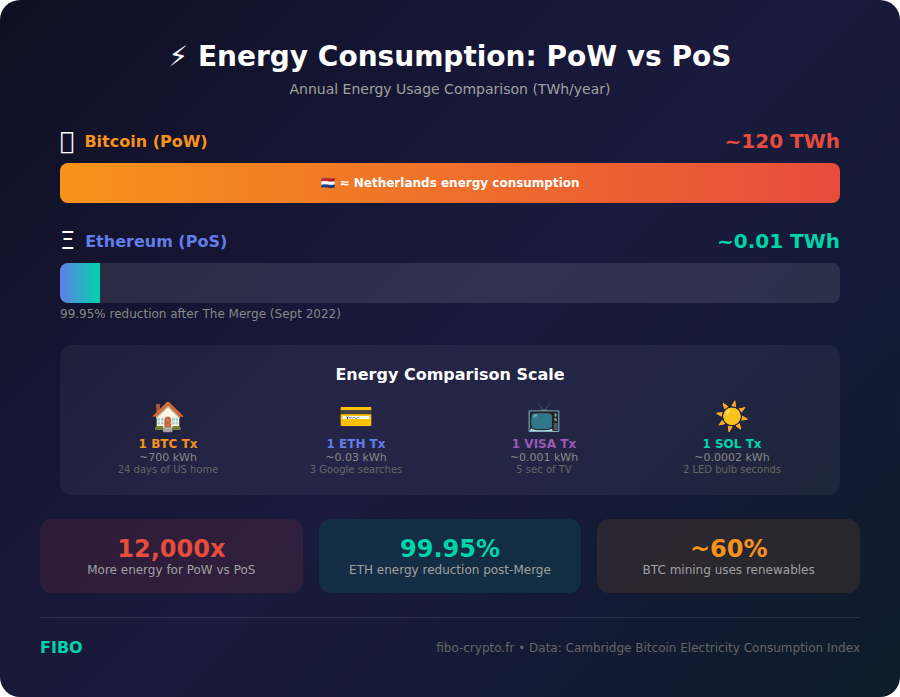
The most dramatic difference lies in energy usage. According to the Cambridge Bitcoin Electricity Consumption Index:
- Bitcoin (PoW): ~120 TWh/year (equivalent to the Netherlands)
- Ethereum (PoS): ~0.01 TWh/year (equivalent to a small town)
- Reduction: 99.95% less energy after Ethereum’s Merge in September 2022
However, it’s worth noting that approximately 60% of Bitcoin mining now uses renewable energy sources, and PoW proponents argue the energy expenditure provides unmatched security.
Security Model
Both mechanisms achieve Byzantine Fault Tolerance through different approaches:
- PoW security comes from the physical world—energy, hardware, and infrastructure that can’t be easily faked or duplicated
- PoS security comes from economic commitment—validators risk losing real financial value if they cheat
A 51% attack on Bitcoin would require acquiring massive physical resources. A similar attack on Ethereum would require purchasing over $20 billion worth of ETH—which would likely trigger price spikes before sufficient accumulation.
Decentralization
Decentralization metrics are nuanced:
- PoW: Mining pools create centralization concerns (top pools control significant hashrate), but anyone can mine
- PoS: Large stakers have more influence, but delegation allows smaller holders to participate; Ethereum has 900,000+ validators
Transaction Speed and Finality
- Bitcoin (PoW): ~10 minutes per block; 6 confirmations (~60 min) for practical finality
- Ethereum (PoS): ~12 seconds per block; finality in ~15 minutes
Other Consensus Mechanisms Worth Knowing
Beyond PoW and PoS, the blockchain ecosystem has developed numerous alternative consensus mechanisms, each optimized for different use cases:
Delegated Proof of Stake (DPoS)
Used by: EOS, TRON, BitShares, Lisk
DPoS introduces a democratic element where token holders vote for a limited number of delegates (typically 21-101) who validate transactions. This creates:
- High throughput: Fewer validators means faster consensus
- Accountability: Poorly performing delegates can be voted out
- Trade-off: More centralized than pure PoS
Proof of Authority (PoA)
Used by: VeChain, private Ethereum networks, enterprise blockchains
In PoA, validators are pre-approved entities who stake their reputation rather than tokens. This suits:
- Enterprise and consortium blockchains
- Situations where participants are known and trusted
- Use cases prioritizing speed over maximum decentralization
Proof of History (PoH)
Used by: Solana
Solana’s innovation combines PoH with PoS. PoH creates a cryptographic timestamp proving that events occurred in a specific sequence, enabling:
- Theoretical throughput of 65,000+ TPS
- Sub-second finality
- Dramatically reduced coordination overhead
Practical Byzantine Fault Tolerance (PBFT)
Used by: Hyperledger Fabric, Zilliqa, some enterprise solutions
PBFT requires validators to communicate in multiple rounds to reach consensus. It provides:
- Instant finality (no risk of reorganization)
- High performance in permissioned settings
- Tolerance for up to 1/3 faulty nodes
Proof of Burn (PoB)
Used by: Slimcoin, Counterparty
Validators “burn” (destroy) cryptocurrency to earn the right to mine blocks. This demonstrates commitment through irreversible sacrifice rather than ongoing energy expenditure.
Proof of Space/Capacity (PoSpace)
Used by: Chia, Filecoin
Instead of computational power, validators prove they’ve allocated storage space. This reduces energy consumption while creating utility (in Filecoin’s case, decentralized storage).
How to Evaluate a Blockchain’s Consensus Mechanism
When researching cryptocurrency projects, consider these factors about their consensus mechanism:
The Blockchain Trilemma
Coined by Ethereum co-founder Vitalik Buterin, the blockchain trilemma states that achieving all three properties simultaneously is extremely difficult:
- Security: Resistance to attacks and manipulation
- Decentralization: No single point of failure or control
- Scalability: Ability to handle high transaction volumes
Different consensus mechanisms make different trade-offs. Bitcoin prioritizes security and decentralization; Solana emphasizes scalability; enterprise chains may sacrifice decentralization for performance.
Questions to Ask
- How many validators/miners secure the network?
- What’s the cost to attack (51% attack)?
- How is power distributed among participants?
- What’s the environmental footprint?
- How long has the mechanism been tested in production?
- What happens if validators misbehave?
The Future of Consensus Mechanisms
Blockchain technology continues to evolve, and consensus mechanisms are at the frontier of innovation:
Emerging Trends
- Hybrid mechanisms: Combining multiple approaches (like Solana’s PoH + PoS)
- Layer 2 solutions: Moving consensus off the main chain for scalability
- Zero-knowledge proofs: Enabling verification without revealing data
- Sharding: Partitioning the network to process transactions in parallel
- DAG-based consensus: Directed Acyclic Graphs instead of linear chains (IOTA, Hedera)
Research Frontiers
Academic and industry researchers are exploring:
- Formal verification of consensus protocols
- Quantum-resistant algorithms
- Cross-chain consensus for interoperability
- Randomness generation for fair validator selection
📚 Glossary
- Consensus Mechanism : A protocol that enables distributed network participants to agree on the validity and order of transactions without central authority.
- Proof of Work (PoW) : A consensus mechanism where miners compete to solve cryptographic puzzles using computational power to validate transactions and create new blocks.
- Proof of Stake (PoS) : A consensus mechanism where validators are selected to create blocks based on the amount of cryptocurrency they stake as collateral.
- Byzantine Fault Tolerance (BFT) : The property of a system that can continue operating correctly even when some nodes fail or act maliciously; can tolerate up to 1/3 faulty nodes.
- Validator : In PoS systems, a node operator who stakes tokens and participates in block validation; equivalent to miners in PoW.
- Slashing : The automatic penalty mechanism in PoS that destroys a portion of a validator’s stake for malicious behavior.
- 51% Attack : An attack where an entity controlling majority hashrate (PoW) or stake (PoS) could potentially double-spend or censor transactions.
- Finality : The guarantee that a transaction cannot be reversed once confirmed; varies by consensus mechanism.
- Staking : The act of locking up cryptocurrency as collateral to participate in network validation and earn rewards.
- Mining : The process of using computational power to validate transactions and create new blocks in PoW networks.
- ASIC (Application-Specific Integrated Circuit) : Specialized hardware designed solely for cryptocurrency mining, offering superior efficiency to general-purpose hardware.
- Delegated Proof of Stake (DPoS) : A PoS variant where token holders vote for delegates who validate transactions on their behalf.
- Proof of Authority (PoA) : A consensus mechanism where pre-approved validators stake their reputation to validate transactions.
- Proof of History (PoH) : Solana’s innovation that creates cryptographic timestamps to prove event ordering, combined with PoS.
- Blockchain Trilemma : The challenge of simultaneously achieving security, decentralization, and scalability in blockchain design.
Frequently Asked Questions
What is the difference between Proof of Work and Proof of Stake?
Proof of Work (PoW) requires miners to solve complex mathematical puzzles using computational power, consuming significant energy but providing battle-tested security. Proof of Stake (PoS) selects validators based on the cryptocurrency they stake as collateral, reducing energy consumption by 99.95% while maintaining security through economic incentives and slashing penalties. Bitcoin uses PoW, while Ethereum transitioned to PoS in 2022.
Why does Bitcoin use Proof of Work instead of Proof of Stake?
Bitcoin uses Proof of Work because it was designed before Proof of Stake existed and has proven secure for over 15 years. PoW provides objective, physical security through energy expenditure that can’t be faked, fair initial coin distribution through mining, and simple, robust protocol design. Many Bitcoin proponents argue the energy cost is justified by the unmatched security and decentralization it provides.
How much energy does Proof of Work consume compared to Proof of Stake?
Proof of Work networks like Bitcoin consume approximately 120 TWh annually—equivalent to a medium-sized country like the Netherlands. Proof of Stake networks like Ethereum (post-Merge) consume only about 0.01 TWh annually. This represents a 99.95% reduction in energy usage. A single Bitcoin transaction uses roughly 700 kWh, while an Ethereum transaction uses about 0.03 kWh—equivalent to just 3 Google searches.
What is Byzantine Fault Tolerance and why does it matter?
Byzantine Fault Tolerance (BFT) is the ability of a distributed system to continue operating correctly even when some participants fail or act maliciously. It originates from the Byzantine Generals Problem—a thought experiment about coordinating attacks when some generals might be traitors. For blockchains, BFT ensures the network reaches consensus even if up to 1/3 of nodes are dishonest, preventing double-spending and ensuring transaction integrity.
Can Proof of Stake be as secure as Proof of Work?
Proof of Stake can achieve comparable security through different means. While PoW security comes from physical resources (energy, hardware), PoS security comes from economic stake at risk. A 51% attack on Ethereum would require acquiring over $20 billion in ETH, and the attacker would lose their stake if caught. Both mechanisms achieve Byzantine Fault Tolerance, though PoW has a longer track record. The Ethereum network has operated securely since transitioning to PoS in September 2022.
What happens if a validator misbehaves in Proof of Stake?
In Proof of Stake systems, misbehaving validators face slashing—the automatic destruction of part or all of their staked tokens. Violations that trigger slashing include proposing two different blocks for the same slot (equivocation), attesting to conflicting blocks, or extended downtime. On Ethereum, slashing penalties start at 1/32 of the stake and can increase to the full 32 ETH. This creates strong economic incentives for honest behavior.
Which consensus mechanism is best for the environment?
Proof of Stake is significantly more environmentally friendly than Proof of Work. Ethereum’s transition from PoW to PoS reduced its energy consumption by 99.95%. Other eco-friendly options include Proof of Space (Chia), which uses storage instead of computation, and Proof of Authority for enterprise use cases. However, it’s worth noting that approximately 60% of Bitcoin mining now uses renewable energy, and some argue PoW incentivizes renewable energy development in remote areas.
What is Delegated Proof of Stake (DPoS)?
Delegated Proof of Stake is a variant where token holders vote for a limited number of delegates (typically 21-101) who validate transactions on their behalf. Used by networks like EOS and TRON, DPoS enables very high transaction throughput since fewer validators need to coordinate. Token holders can vote out underperforming delegates, creating accountability. The trade-off is increased centralization compared to pure PoS systems.
📰 Sources
This article is based on the following sources:
- Bitcoin Whitepaper by Satoshi Nakamoto
- Ethereum Proof of Stake Documentation
- Cambridge Bitcoin Electricity Consumption Index
- The Byzantine Generals Problem (Lamport, Shostak, Pease, 1982)
- Practical Byzantine Fault Tolerance (Castro & Liskov, 1999)
- Ethereum’s Energy Consumption Post-Merge
Comment citer cet article : Fibo Crypto. (2026). Consensus Mechanisms Explained: PoW vs PoS & How Blockchains Agree. Consulté le 21 July 2026 sur https://fibo-crypto.fr/en/blog/consensus-mechanisms-explained/
The simplest way to buy, swap and manage your crypto
Join the first users and get priority access. No seed phrase, fees 3.5x lower, built-in DeFi yield.
Join the waitlist →