What is a Bitcoin Satoshi (SAT)?
📋 En bref (TL;DR)
- Definition: A satoshi (sat) is the smallest unit of Bitcoin — 1 satoshi = 0.00000001 BTC
- Divisibility: 1 bitcoin = 100 million satoshis, enabling transactions worth just a few cents
- Origin: Named in honor of Satoshi Nakamoto, Bitcoin’s anonymous creator
- Practical utility: Makes Bitcoin accessible to all budgets — you can invest with just $1
- Applications: Microtransactions, Lightning Network, DeFi, progressive accumulation (DCA)
- Scarcity: There will never be more than 2.1 quadrillion satoshis (21M BTC × 100M sats)
You’ve heard about Bitcoin, but did you know it’s divisible into 100 million tiny units? These units are called satoshis (or “sats”), and they’re revolutionizing how we use and perceive cryptocurrencies.
What Exactly Is a Satoshi?
A satoshi is the smallest fraction of a bitcoin. Its name honors Satoshi Nakamoto, the pseudonymous creator of Bitcoin who published the founding whitepaper in 2008.
2x cheaper fees. Up to 6% yield. No seed phrase. Fibo, the wallet you've been waiting for.
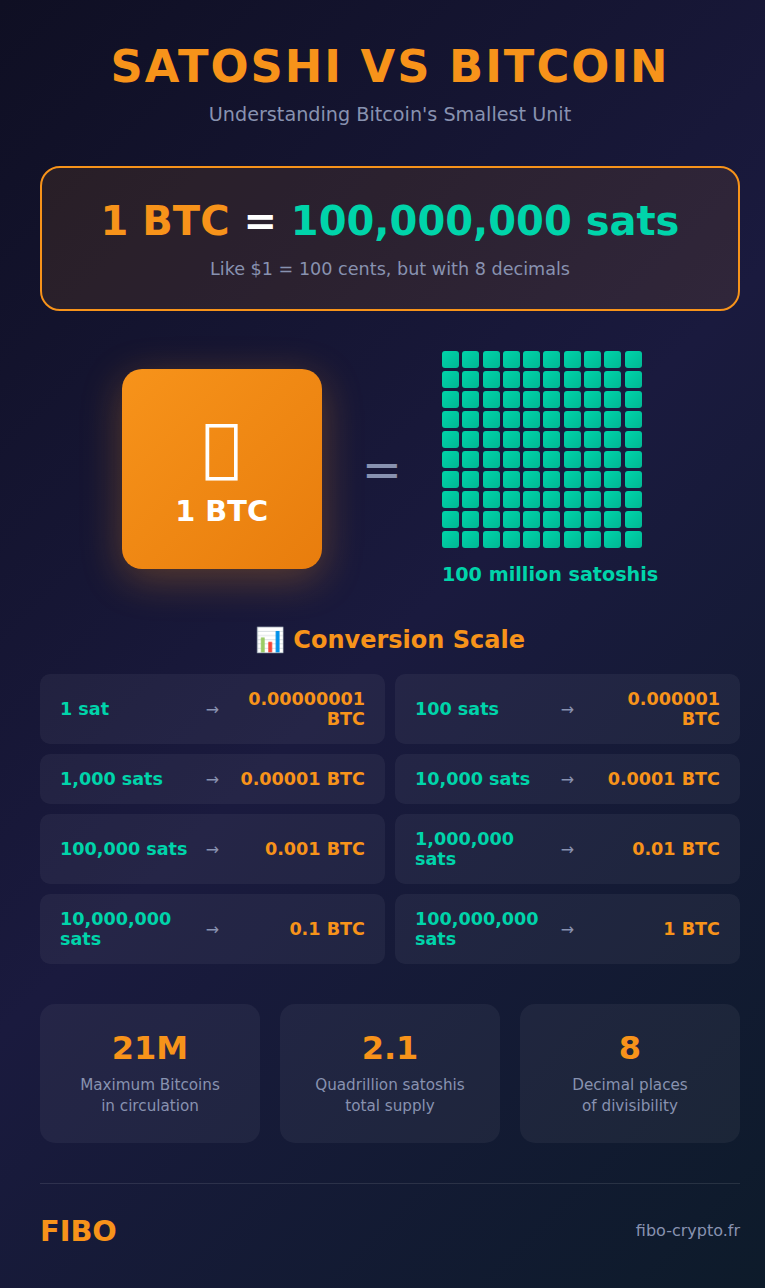
Join the waitlist →The mathematical relationship is simple: 1 bitcoin = 100,000,000 satoshis (one hundred million). This means Bitcoin has 8 decimal places, offering extremely fine granularity for transactions.
🔢 Simple comparison: If $1 = 100 cents, then 1 bitcoin = 100 million satoshis. We go from 2 decimals to 8 decimals!
Why Are Satoshis Essential?
Universal Accessibility
With a bitcoin worth tens of thousands of dollars, not everyone can buy a whole BTC. But thanks to satoshis, anyone can invest in Bitcoin with just a few dollars. This divisibility makes cryptocurrency truly inclusive.
Microtransactions and Tips
Satoshis allow you to send tiny amounts — just a few cents — without the prohibitive fees of traditional banking systems. This is ideal for:
- Tips to content creators
- Micropayments for articles or digital services
- Small charitable donations
- Games and decentralized applications
Lightning Network: Sats in Action
The Lightning Network is a payment layer built on Bitcoin that enables instant, near-free transactions. This technology works natively in satoshis, making it possible to pay for your coffee in sats!
How to Convert Satoshis and Bitcoins?
The conversion is simple: divide or multiply by 100 million.
- 1 sat = 0.00000001 BTC
- 100 sats = 0.000001 BTC
- 1,000 sats = 0.00001 BTC
- 10,000 sats = 0.0001 BTC
- 100,000 sats = 0.001 BTC
- 1,000,000 sats = 0.01 BTC
- 10,000,000 sats = 0.1 BTC
- 100,000,000 sats = 1 BTC
💡 Tip: To find out the dollar value of your sats, divide by 100 million then multiply by the current Bitcoin price.
The Programmed Scarcity of Satoshis
Bitcoin has a maximum supply fixed at 21 million BTC. Not a single satoshi more will ever be created. This programmed scarcity is written into Bitcoin’s source code.
In terms of satoshis, this represents a maximum of 2.1 quadrillion sats (2,100,000,000,000,000). With Bitcoin’s growing adoption worldwide, each satoshi potentially becomes more valuable over time.
Real-World Use Cases for Satoshis
Dollar-Cost Averaging (DCA)
The DCA strategy involves investing a fixed amount regularly (e.g., $10 per week). Thanks to satoshis, even small investments allow you to gradually accumulate Bitcoin.
Education and Learning
Satoshis are perfect for getting started with Bitcoin. Sending a few sats between wallets helps you understand how transactions work without risking much.
Price Display
More and more merchants accepting Bitcoin display their prices in sats. Saying “50,000 sats” is more intuitive than “0.0005 BTC”.
Where to Store Your Satoshis?
Your satoshis are stored in a Bitcoin wallet. Several options exist depending on your needs:
- Hot wallets (connected): mobile or desktop apps for daily use
- Cold wallets (offline): hardware wallets like Ledger or Trezor for maximum security
- Lightning wallets: specialized for fast microtransactions (Phoenix, Muun, Wallet of Satoshi)
📚 Glossary
- Bitcoin : The first decentralized cryptocurrency created in 2009, operating on a blockchain and limited to 21 million units.
- Satoshi : The smallest unit of Bitcoin, equal to 0.00000001 BTC. Named in honor of Bitcoin’s creator.
- Satoshi Nakamoto : Pseudonym of Bitcoin’s anonymous creator, author of the 2008 whitepaper.
- Lightning Network : Second-layer solution on Bitcoin enabling instant transactions with very low fees.
- Wallet : Digital wallet for storing, sending, and receiving cryptocurrencies.
- Hardware wallet : Physical wallet (secure USB device) storing private keys offline.
- DCA (Dollar-Cost Averaging) : Investment strategy of buying a fixed amount regularly.
- Halving : Halving of Bitcoin mining rewards, occurring approximately every 4 years.
- Whitepaper : Technical document describing how a crypto project works. Bitcoin’s was published on October 31, 2008.
- Cryptocurrency : Digital currency using cryptography, operating in a decentralized manner on a blockchain.
Frequently Asked Questions
How much is 1 satoshi worth in dollars?
The value of a satoshi depends on Bitcoin’s price. Divide the price of one BTC by 100 million to get the value of one sat. For example, if Bitcoin = $80,000, then 1 sat = $0.0008 (less than a tenth of a cent).
Can you buy less than one satoshi?
No, the satoshi is Bitcoin’s indivisible unit on the main blockchain. However, on the Lightning Network, even smaller units called “millisatoshis” (0.001 sat) exist for fee calculations.
Why use satoshis instead of bitcoins?
Satoshis are more practical for expressing small amounts. Saying “I have 50,000 sats” is more intuitive than “I have 0.0005 BTC”. They also eliminate the psychological barrier of not being able to “buy a whole bitcoin.”
Will satoshis increase in value?
If Bitcoin continues to appreciate and become scarcer (supply limited to 21 million), then mechanically each satoshi becomes more valuable. However, like any investment, past performance doesn’t guarantee future results.
How do I send satoshis to someone?
You need a Bitcoin wallet and the recipient’s address. For small amounts and fast transactions, use a Lightning Network-compatible wallet. Fees will be near zero and the transfer instant.
📰 Sources
This article is based on the following sources:
- Bitcoin Whitepaper – Satoshi Nakamoto
- Lightning Network Whitepaper
- Bitcoin Wiki – Units
- Investopedia – Satoshi
Comment citer cet article : Fibo Crypto. (2026). What is a Bitcoin Satoshi (SAT)?. Consulté le 21 March 2026 sur https://fibo-crypto.fr/en/blog/what-is-a-bitcoin-satoshi-sat
The simplest way to buy, swap and manage your crypto
Join the first users and get priority access. No seed phrase, fees 3.5x lower, built-in DeFi yield.
Join the waitlist →