Solana Crypto Analysis: Why Buy This Cryptocurrency?
📋 En bref (TL;DR)
- Solana : ultra-fast blockchain capable of processing up to 65,000 transactions per second with fees below $0.01
- Proof of History : innovative consensus mechanism created by Anatoly Yakovenko to accelerate transaction validation
- Use cases : DeFi, NFTs, and instant payments via Solana Pay, with growing adoption
- Market cap : over 60 billion euros, equivalent to Orange, Pernod-Ricard, Renault, and Veolia combined
- Challenges : past network outages, competition from Ethereum and Polygon, and crypto market volatility
Introduction
The world of crypto assets can seem complex for someone new to investing and digital assets, with technical jargon and innovative concepts. Yet, certain blockchains, like Solana, aim to make these technologies more accessible, fast, and affordable. Discover why buying the Solana crypto could be an opportunity.
But what is Solana exactly? How does it work and how does it differ from other blockchains like Bitcoin and Ethereum? Could it replace Mastercard for payments?
2x cheaper fees. Up to 6% yield. No seed phrase. Fibo, the wallet you've been waiting for.
Get early access →In this article, we’ll break down Solana by explaining everything in a simple and clear way, even if you’re a complete beginner in the cryptocurrency world.
Understanding the Basics: Blockchains and Crypto Assets
What Is a Blockchain and How Does It Work?
A blockchain is a decentralized database that records transactions securely and transparently. Decentralized means there is no single entity controlling the blockchain. In other words, the Solana blockchain belongs to no one and cannot be modified by a third party.
Illustrating Our Point: The Solana Blockchain
A blockchain is like a giant digital book. Everyone can write in it, and nobody can erase what has been written.
Let’s take an example: you forget your wallet and borrow €100 from a friend. The next day, you pay them back the €100. But if your friend isn’t honest, they could say you never paid them back. It’s your word against theirs.
Instead of exchanging a €100 bill, imagine you used Solana crypto. Your friend sends you €100 in crypto, and you send back the equivalent the next day. This time, your 2 transactions are recorded in the “Blockchain” book. So everyone can see that you did pay back your friend, and they cannot erase that transaction from the book. So blockchain is an extremely secure ledger.
This blockchain book is shared: many people have a digital copy of this ledger. So if someone tries to modify one of the books, all the other books will prove that the modified one is false. It’s secure: no one can cheat, erase data, or change pages, not even the best coders in the world. It’s unbreakable: even if someone tries to tear out a page or destroy one of the books, the other versions will always remain intact.
All of this, without intermediaries. There’s no bank or management company controlling transactions. It’s the users who have control because everything is transparent. Financial fraud and embezzlement are impossible on the Blockchain.
To Summarize, the Solana Blockchain
- Secure: The blockchain is nearly impossible to hack due to cryptography and its decentralization.
- Transparent: All transactions are public and can be verified at any time.
- No intermediaries: Transactions are made directly between parties without a bank or central authority.
Solana Crypto in Numbers – Why Is It So Different?
Solana was created to solve the slowness and high fee problems encountered by blockchains like Ethereum.
Solana has a market capitalization of over 60 billion euros. That’s the equivalent of the companies Orange, Pernod-Ricard, Renault, and Veolia combined.


Among other things, here are the key performances of the Solana blockchain:
- Transaction speed: Up to 65,000 TPS (transactions per second).
- Ultra-low fees: Less than $0.01 per transaction.
- Active users: More than 11 million Solana wallets.
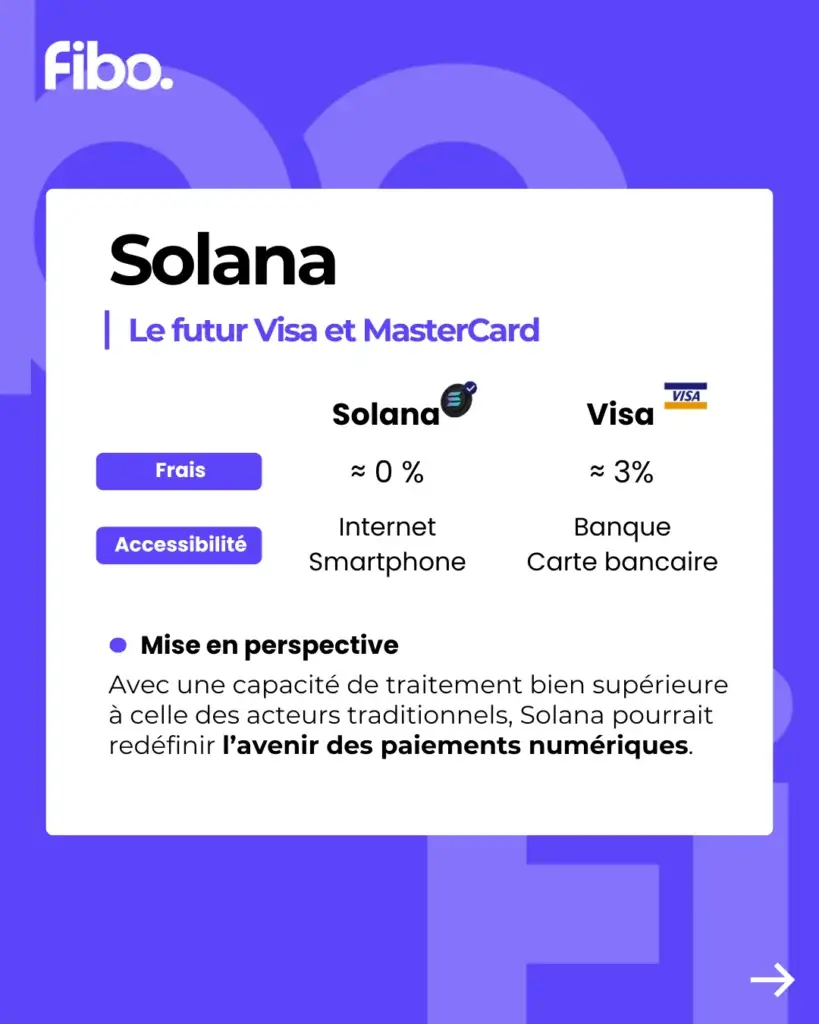
With such performance, Solana can handle a transaction volume close to that of the biggest payment players: Visa and MasterCard.
Who Created Solana Crypto?
Solana was founded in 2017 by Anatoly Yakovenko, an engineer who had worked at Qualcomm, specializing in mobile network technologies.
Why Was Solana Crypto Created?
The founder of the Solana blockchain, Anatoly Yakovenko, noticed that traditional blockchains like Bitcoin and Ethereum are often too slow and too expensive due to congested networks or non-optimized technologies. He then designed a new security system called Proof of History (PoH) to accelerate transactions.
What Is the Purpose of Solana Crypto?
Decentralized Finance (DeFi)
What Is DeFi?
Decentralized Finance (DeFi) is a new generation of finance that allows borrowing, lending, and investing without a banking intermediary.
💡 Example: With Solana, you can lend your cryptocurrencies and earn interest, without going through a bank.
NFTs (Non-Fungible Tokens) on the Solana Blockchain
NFTs (non-fungible tokens) are digital certificates that prove ownership of a unique digital work (image, video, music).
Buying an NFT is similar to acquiring a physical artwork, but in digital form, with a secure record on the blockchain.
Although NFTs are primarily known through digital art, their uses are much broader. Indeed, NFTs can be used to authenticate real-world objects, such as in the luxury industry or healthcare sector.
Why Choose the Solana Blockchain for NFTs?
- Low transaction fees
Fees on Solana are virtually non-existent, well below those of Ethereum, allowing you to buy and sell NFTs at lower cost, even for small transactions. - Ultra-fast transactions
With its exceptional processing speed, Solana enables near-instantaneous transactions, unlike Ethereum which can be slower during network congestion. - Improved accessibility
Solana is simpler to use and more accessible than Ethereum, enabling many creators and collectors to get started without major financial or technical barriers.
In conclusion, Solana is an ideal blockchain for NFTs, offering reduced fees, fast transactions, and better accessibility for creators and collectors.
Solana Pay: Can It Replace MasterCard?
What Is Solana Pay?
Launched in 2022, Solana Pay is a service that allows sending and receiving cryptocurrency payments without intermediaries, directly via the Solana blockchain. Unlike traditional bank cards, this system relies on decentralization, offering more transparency and control to users.
The New MasterCard?
Solana Pay offers undeniable advantages, particularly for businesses and merchants looking to reduce costs and avoid financial intermediaries.
However, there are still several challenges to overcome before it can compete with Mastercard and Visa:
- Limited adoption: Few merchants still accept crypto payments.
- Cryptocurrency volatility: The value of SOL fluctuates, which can be a barrier to daily use.
- Evolving regulations: Some countries still impose restrictions on crypto payments.
A Step Toward the Future with Blockchain Payments?
Solana Pay won’t immediately replace bank cards, but its innovation potential is immense. If crypto adoption continues to grow and regulations adapt, this type of solution could well become a digital payment standard.
Some international platforms have already integrated Solana as a payment method. Notably, the Shopify platform now allows payments via Solana crypto.
📌 Solana Pay already enables instant crypto payments with virtually no fees.
How to Buy Solana?
If you want to buy the Solana crypto asset, several options are available to you.
The digital asset ecosystem is still young, and caution is advised. Make sure to choose your investment platform carefully, prioritizing security and reliability.
Once you’ve decided which platform you want to invest with, the steps are often similar from one platform to another:
- Create an account on your preferred platform (we obviously recommend our Fibo platform, especially if it’s your first crypto investment)
- Complete a Solana purchase in just a few clicks.
- Follow the evolution of the Solana blockchain. It’s essential to follow the news and trends of the ecosystem. At Fibo, we’re here to support you, and we follow the market to save you time and energy.
📌 Schedule an appointment with one of our finance & crypto experts to build your investment project.
What Future for Solana Crypto?
Since its launch, Solana has established itself as a high-performing and promising blockchain. Its ecosystem is growing rapidly, attracting businesses and developers. But to succeed long-term, it must overcome several challenges and continue innovating.
Rapidly Growing Adoption
Solana is attracting more and more Web3 players thanks to its speed and low fees. Companies are already integrating its solutions, like Solana Pay, which facilitates instant crypto payments. The NFT sector on Solana is also booming, attracting artists and investors. Meanwhile, decentralized finance (DeFi) leverages its performance to offer alternatives to traditional banks. This enthusiasm is reflected in user numbers: more than 11 million active wallets already interact with the network.
Why Is This Important?
Broader adoption means more transactions, more innovations, and increased stability for Solana. The more users there are, the stronger the network becomes.
Technological and Economic Challenges
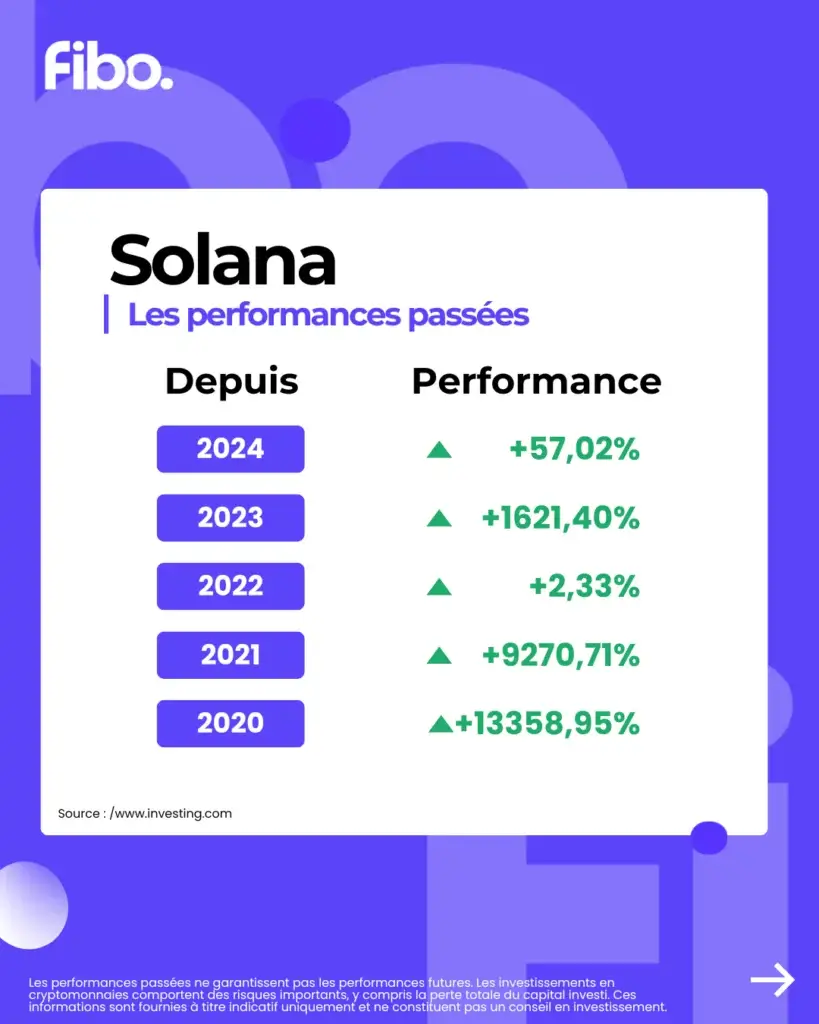
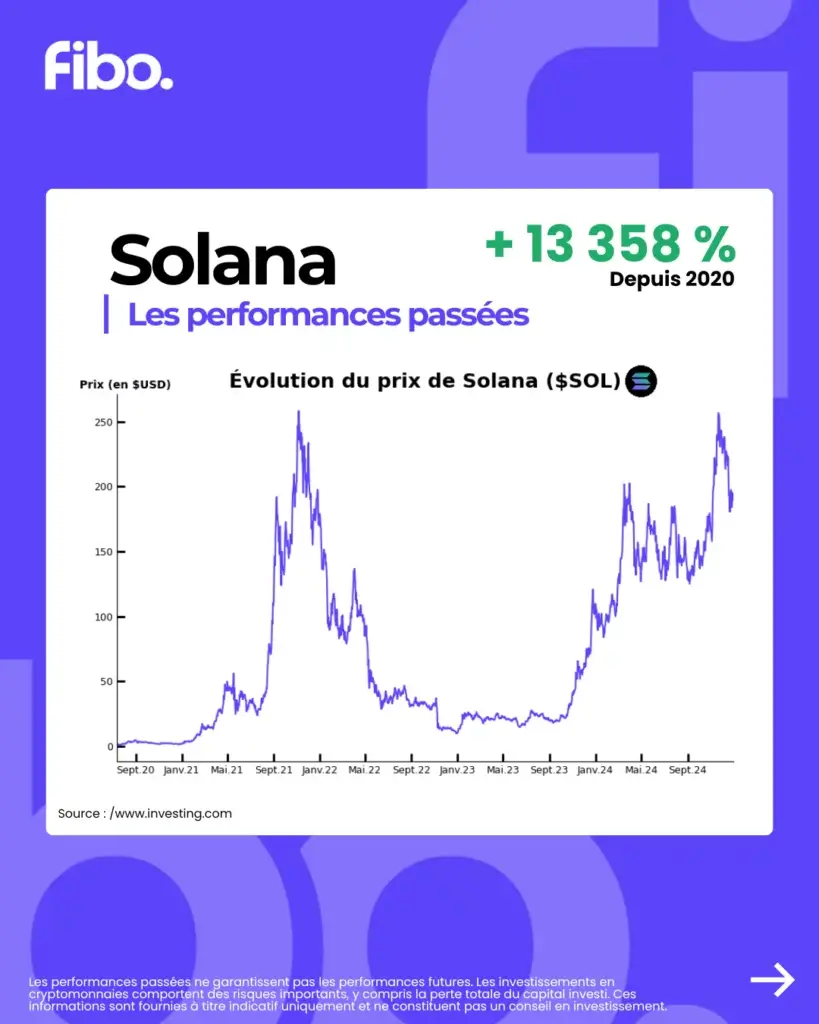
Despite its success, Solana still has to prove itself. Its network has experienced several outages, raising doubts about its reliability. Although improvements are underway, stability remains a key issue. Additionally, competition with Ethereum and Polygon is intensifying: these blockchains are evolving and could limit Solana’s growth. Finally, crypto market volatility complicates mass adoption. Like all cryptocurrencies, the price of SOL experiences significant fluctuations, which can deter some investors.
Upcoming Innovations and Improvements
To strengthen its position, Solana is banking on several developments. The team is improving infrastructure to reduce outages and secure the network. Solana is also diversifying with the Solana Saga smartphone, designed to facilitate access to Web3 applications. Finally, it’s multiplying partnerships to integrate blockchain into sectors such as payments, finance, and gaming.
Your Crypto Partner, Fibo
The cryptocurrency market is evolving rapidly and can seem technical and hard to access. That’s why Fibo Crypto provides beginner and experienced investors with detailed analyses and educational tools to make informed and strategic decisions.
Our Commitments
- In-depth analyses and updates on emerging cryptocurrencies and market trends
- Comprehensive guides and training to understand fundamentals and avoid common mistakes
- Investment strategies tailored to both beginner and advanced profiles
- Market monitoring and advice to optimize risk management and identify opportunities
📌 At Fibo, we favor a structured and educational approach to help our members navigate this world with confidence and peace of mind.
👉 Discover our investment solutions now!
📚 Glossary
- Solana : High-performance blockchain created in 2017 by Anatoly Yakovenko, capable of processing up to 65,000 transactions per second with near-zero fees.
- Blockchain : A decentralized and immutable digital ledger that records transactions securely and transparently, without a centralized intermediary.
- Bitcoin : The first decentralized cryptocurrency, created in 2009 by Satoshi Nakamoto. Often considered “digital gold.”
- Ethereum : A programmable blockchain created in 2015, enabling the execution of smart contracts and deployment of decentralized applications (dApps).
- Proof of History (PoH) : An innovative consensus mechanism developed by Solana that timestamps transactions to accelerate their validation without sacrificing security.
- DeFi : Decentralized Finance. An ecosystem of financial services (lending, borrowing, trading) operating on blockchain without banking intermediaries.
- NFT : Non-Fungible Token. A unique digital certificate recorded on the blockchain, proving ownership of a digital asset (image, video, music).
- Web3 : The new generation of decentralized internet based on blockchain, where users control their data and digital assets.
Frequently Asked Questions
What makes Solana faster than Ethereum?
Solana uses a unique mechanism called Proof of History (PoH) that timestamps transactions before their validation, significantly reducing processing time. Result: up to 65,000 transactions per second compared to about 15-30 for Ethereum, with fees below $0.01.
Can Solana Pay replace bank cards?
Not immediately. Solana Pay offers instant payments with near-zero fees, but merchant adoption remains limited, SOL’s volatility hinders daily use, and regulations are still evolving. However, platforms like Shopify have already integrated it.
What are the risks of investing in Solana?
The main risks include SOL price volatility, past network outages that question reliability, and growing competition from Ethereum and Polygon. As with any crypto investment, only invest what you can afford to lose.
📰 Sources
This article is based on the following sources:
Comment citer cet article : Fibo Crypto. (2026). Solana Crypto Analysis: Why Buy This Cryptocurrency?. Consulté le 21 July 2026 sur https://fibo-crypto.fr/en/blog/solana-crypto-analysis/
The simplest way to buy, swap and manage your crypto
Join the first users and get priority access. No seed phrase, fees 3.5x lower, built-in DeFi yield.
Get early access →