What Is a Bitcoin ETF?
📋 En bref (TL;DR)
- Bitcoin ETF: Regulated financial product allowing investment in Bitcoin through a regular brokerage account, without directly holding BTC
- Spot vs Futures ETF: Spot ETFs (IBIT, FBTC) hold real bitcoins and track the actual price; futures ETFs use contracts with less precise tracking
- Historic approval: On January 10, 2024, the SEC approved the first spot Bitcoin ETFs in the United States, opening the door to institutional investors
- Top 3 ETFs: iShares IBIT (BlackRock, $50B+ AUM), Fidelity FBTC ($15B+), ARK 21Shares ARKB ($4B+) — fees between 0.21% and 0.25%
- Advantages: Simplicity (no wallet needed), regulation, accessibility via regular broker, tax-advantaged accounts eligible
- Disadvantages: No control over BTC (« not your keys »), annual fees, limited market hours, counterparty risk
A Bitcoin ETF (Exchange-Traded Fund) is a financial product that allows you to invest in Bitcoin through traditional stock markets, without having to buy, store, or secure bitcoins yourself. It’s the simplest entry point for investors who want BTC exposure in a regulated framework.
How Does a Bitcoin ETF Work?
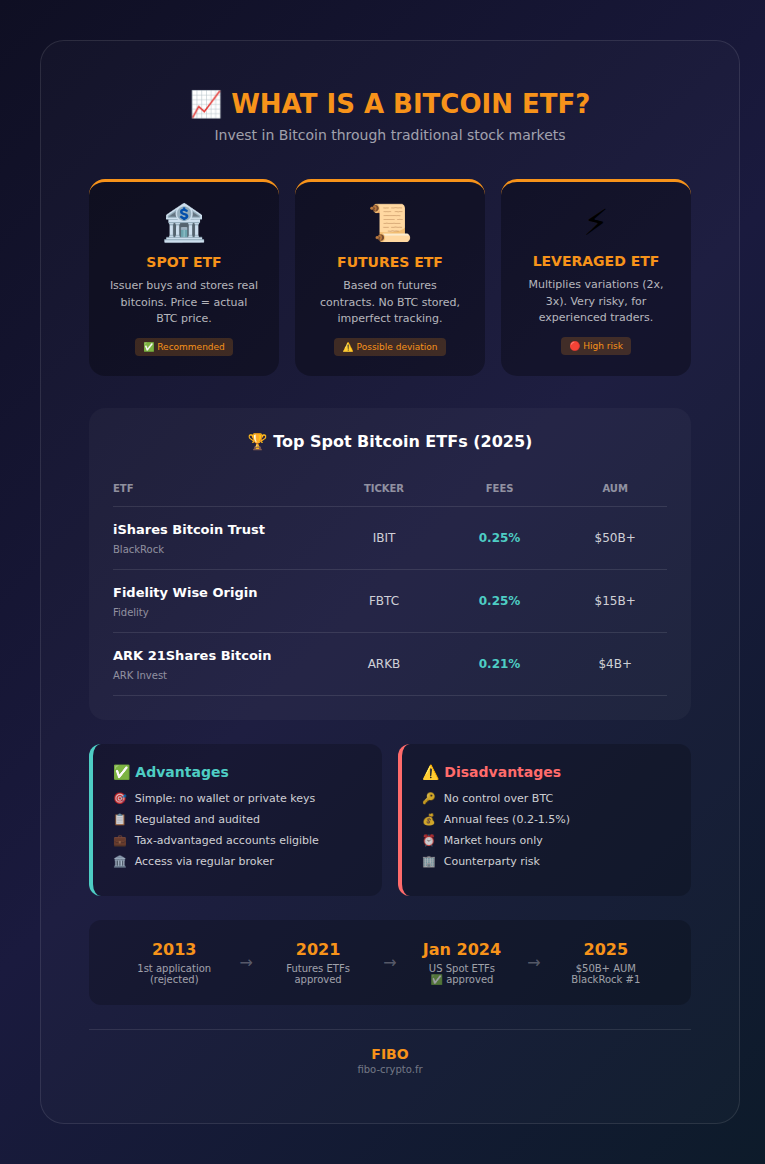
A Bitcoin ETF works like any stock market ETF: you buy shares through your regular broker, and the fund replicates the performance of the underlying asset. But there are several types of Bitcoin ETFs with different mechanisms.
2x cheaper fees. Up to 6% yield. No seed phrase. Fibo, the wallet you've been waiting for.
Get early access →Spot ETF (Physically-Backed)
The issuer buys and stores real bitcoins in secure cold wallets. ETF shares track the BTC price closely.
- ✅ Best tracking of actual price
- ✅ Direct exposure to Bitcoin
- 📌 Examples: IBIT (BlackRock), FBTC (Fidelity), ARKB (ARK Invest)
Futures ETF
Based on Bitcoin futures contracts (promise to buy BTC at a future date). The issuer doesn’t hold actual bitcoins.
- ⚠️ Imperfect tracking (possible deviation from spot price)
- ⚠️ « Roll » costs when renewing contracts
- 📌 Examples: BITO (ProShares), BTF (Valkyrie)
Leveraged ETF
Aims to multiply Bitcoin’s daily variations (2x, 3x). Very risky, reserved for experienced traders.
- 🔴 Risk of amplified losses
- 🔴 Erosion effect over long term
- 📌 Examples: BITX (2x), various synthetic products
Top Bitcoin Spot ETFs in 2025
Since the historic January 2024 approval, US spot Bitcoin ETFs have attracted tens of billions of dollars. Here are the market leaders:
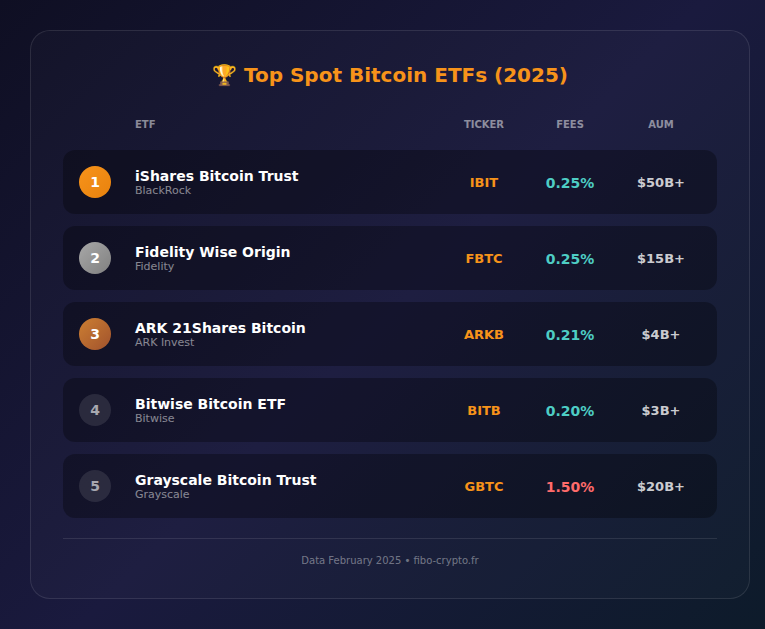
Note: GBTC was a trust before being converted to an ETF. Its higher fees (1.5%) explain the capital outflows to cheaper competitors.
History: The Long Road to Approval
- 2013: First Bitcoin ETF application by the Winklevoss twins — rejected by the SEC
- 2017-2023: Multiple applications rejected for « market manipulation risk »
- 2021: Approval of first Bitcoin futures ETFs in the US (BITO)
- January 2024: Historic approval of spot Bitcoin ETFs by the SEC
- 2025: BlackRock IBIT becomes the largest Bitcoin ETF in the world, exceeding $50 billion in assets
Why Invest in a Bitcoin ETF?
✅ Advantages
- Simplicity: No need for a wallet, private keys, or understanding blockchain
- Regulation: Audited product, regulated issuers (BlackRock, Fidelity…)
- Accessibility: Buy/sell via any broker (Schwab, Fidelity, Interactive Brokers…)
- Tax benefits: Compatible with tax-advantaged accounts (IRA, 401k in the US)
- Liquidity: High volumes, tight spreads
⚠️ Disadvantages
- No control: « Not your keys, not your coins » — you depend on the issuer
- Fees: 0.2% to 1.5% annually + brokerage fees
- Limited hours: Trading only during market hours (not 24/7)
- Counterparty risk: Dependence on issuer and custodian soundness
- No utility: Cannot use BTC for payments or DeFi
How to Buy a Bitcoin ETF
- Choose a broker: Fidelity, Schwab, Interactive Brokers, Robinhood, E*TRADE…
- Open a brokerage account: Provide identity documents (KYC)
- Deposit funds: Bank transfer or linked account
- Search for the ETF: By ticker (IBIT, FBTC…) or name
- Place an order: During market hours (9:30 AM – 4:00 PM ET for US ETFs)
- Monitor your investment: DCA strategy recommended to smooth volatility
Bitcoin ETF vs Direct Purchase: What to Choose?
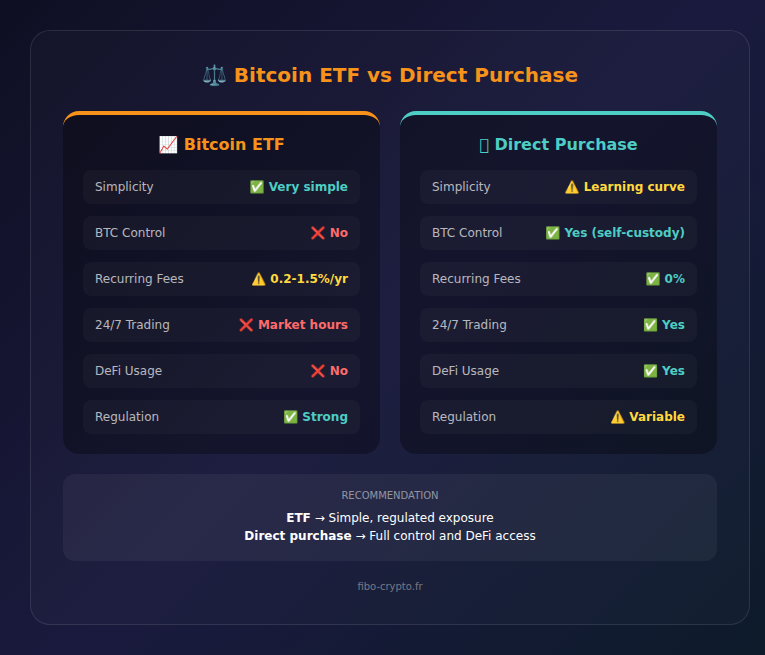
Recommendation: ETFs suit investors who want simple, regulated exposure. Direct purchase is better for those who want to control their BTC or use DeFi.
📚 Glossaire
- ETF (Exchange-Traded Fund) : Fund traded on stock exchanges that replicates the performance of an underlying asset. Bought and sold like a stock.
- Spot ETF : ETF that physically holds the underlying asset (here, real bitcoins stored in cold wallets).
- Futures ETF : ETF based on futures contracts, without physical ownership of the asset.
- AUM (Assets Under Management) : Measures a fund’s size.
- SEC : Securities and Exchange Commission. US financial markets regulator.
- Ticker : Short code identifying a security on the exchange (e.g., IBIT, FBTC).
- Management fees : Annual percentage taken from fund assets to cover operational costs.
- Custodian : Company that physically stores bitcoins on behalf of the ETF.
- Tracking : An ETF’s ability to faithfully follow the underlying asset’s price.
- DCA (Dollar-Cost Averaging) : Regular investment strategy to smooth entry price.
Questions fréquentes
What is the best Bitcoin ETF in 2025?
The iShares Bitcoin Trust (IBIT) from BlackRock is the largest spot Bitcoin ETF with over $50 billion in assets. It offers competitive fees (0.25%) and excellent liquidity. Fidelity FBTC and ARK 21Shares ARKB are also excellent options with similar or slightly lower fees.
Can I buy a Bitcoin ETF in my IRA or 401k?
Yes, most spot Bitcoin ETFs (IBIT, FBTC, ARKB) are eligible for tax-advantaged accounts like IRAs and 401ks, provided your plan administrator allows them. This can offer significant tax benefits compared to holding crypto directly.
Are Bitcoin ETFs safe?
Spot Bitcoin ETFs are issued by regulated asset managers (BlackRock, Fidelity) and audited. The bitcoins are stored with specialized custodians (Coinbase Custody). The main risk is counterparty risk (issuer or custodian bankruptcy), which remains low for major asset managers.
What's the difference between spot and futures ETFs?
A spot ETF holds real bitcoins and precisely tracks the BTC price. A futures ETF uses futures contracts without holding actual BTC, which can create tracking errors and additional costs when rolling contracts. Spot ETFs are generally preferable for long-term investment.
Why not just buy Bitcoin directly?
Direct purchase offers more control but requires managing security (wallet, private keys, seed phrase). ETFs suit those who want simple exposure without this technical complexity, or who wish to invest through an existing brokerage account (potential tax benefits).
📰 Sources
Cet article s'appuie sur les sources suivantes :
- SEC Approves Bitcoin ETFs (January 2024)
- iShares Bitcoin Trust (IBIT)
- Fidelity Wise Origin Bitcoin Fund
- ETF.com Bitcoin ETF Tracker
Comment citer cet article : Fibo Crypto. (2026). What Is a Bitcoin ETF?. Consulté le 5 février 2026 sur https://fibo-crypto.fr/en/blog/what-is-a-bitcoin-etf
The simplest way to buy, swap and manage your crypto
Join the first users and get priority access. No seed phrase, fees 3.5x lower, built-in DeFi yield.
Get early access →