Understanding Bitcoin: Complete Guide for Beginners
📋 En bref (TL;DR)
- What is Bitcoin? : A peer-to-peer electronic payment system, the first decentralized digital currency
- Created in 2009 : By the mysterious Satoshi Nakamoto, whose identity remains unknown
- Limited supply : Only 21 million bitcoins will ever exist, protecting against inflation
- Key features : Decentralized, transparent, fast international transfers, and secure
Wondering what Bitcoin is? You’re not alone. Many people are curious about this digital currency that’s generating so much buzz. In just a few years, Bitcoin has transformed how we think about finance and money transfers.
This comprehensive guide is designed to help you understand Bitcoin basics. We’ll discuss how it works, its characteristics, and what makes it so popular. Whether you’re a beginner or just curious, this journey into the world of Bitcoin could change how you view money.
2x cheaper fees. Up to 6% yield. No seed phrase. Fibo, the wallet you've been waiting for.
Download Fibo →
What is Bitcoin?
In his famous paper, which you can read here, Bitcoin is defined as a “peer-to-peer electronic cash system.” This may seem complex, but it’s hard to find a simpler yet more accurate definition of Bitcoin.
This definition requires us to explain the underlying concepts of “electronic payment system” and “peer-to-peer.”
Bitcoin: An Electronic Payment System…
Bitcoin’s primary use is therefore to pay. It allows users to transfer value (money) over the Internet without needing physical bills or coins. This is why we call it a digital currency.
Reading this, you might think: “That’s just like paying online with my credit card, nothing new.”
And you’d be right. Bitcoin’s true significance comes from the second part of the definition: “peer-to-peer.”
Bitcoin: …Peer-to-Peer
The term “peer-to-peer” gives Bitcoin a completely different dimension. It describes a system where each network user is both client and server, without a central intermediary.
Simply put, it’s a free system that answers to no company, no government, and no religious or political authority: it belongs to everyone, and to no one in particular.
In Bitcoin’s context, this means:
- ✅ Users can send and receive money directly between themselves
- ✅ Without going through a bank, payment processor, or central platform
What’s the Benefit of a Decentralized System?
The benefits of a decentralized network for Bitcoin are numerous: security, transparency, a service open to all without discrimination… The advantages are many.
But one of the strongest is certainly the ability to hold your own money.
💡 Did you know?
In 2022, Canada froze over $3 million without a court order. The funds belonged to protesters against Covid-19 health measures. A first, made possible by the exceptional activation of the Emergencies Act.
Key Characteristics of Bitcoin
- Decentralized: No central control
- Transparent: Every transaction is recorded on the blockchain
- Low fees: Lower fees than traditional bank transfers
- Speed: Blockchain transactions take just minutes
- Limited supply: There will never be more than 21 million bitcoins in circulation
These traits make Bitcoin a unique asset, attracting more and more investors and users. It’s a financial revolution changing how we perceive money and transactions. Let’s detail these points.
Unmatched Bitcoin Payment Speed
Thanks to technology and scientific advances, we can now perform tasks at lightning speed. However, an international bank transfer still takes 5 business days.

A Supply Limited to 21 Million Bitcoins
Money creation is a vast topic that deserves its own complete article.
One important point to remember:
- Central banks like the ECB (European Central Bank) have the power to create money. You can imagine this like the Netflix series “Money Heist” where we see printing presses churning out cash.
This money creation devalues your savings. We call this inflation.
Illustration by example:
Imagine a small village with:
• 10 loaves of bread
• 10 €1 bills in circulation
A loaf naturally costs €1.
Now, suppose suddenly 10 more bills are printed:
• Still 10 loaves
• But now 20 bills in circulation
People have more money, but the amount of bread hasn’t changed. Sellers will therefore raise prices.
Result: a loaf now costs €2 instead of €1.
That’s inflation: when the amount of money increases but not the quantity of goods, prices rise.
Unlike traditional currencies, Bitcoin cannot be arbitrarily manipulated. Its code explicitly states there will never be more than 21 million bitcoins. Etched into the protocol, this cap is immutable.
Origin and Creation of Bitcoin
Who Created Bitcoin?
Bitcoin was created in 2009 by a person or group using the pseudonym Satoshi Nakamoto. This name remains a mystery, as Nakamoto’s real identity has never been revealed.
There are many theories about Satoshi Nakamoto’s identity. Curious investigators have proposed candidates ranging from cryptographers to tech entrepreneurs, but none have been confirmed.
How Does Bitcoin Work?
Understanding Bitcoin is crucial for new investors. Bitcoin is a digital currency based on blockchain technology. Its operation may seem obscure. Here are key points to better understand this value transfer tool.
The Blockchain
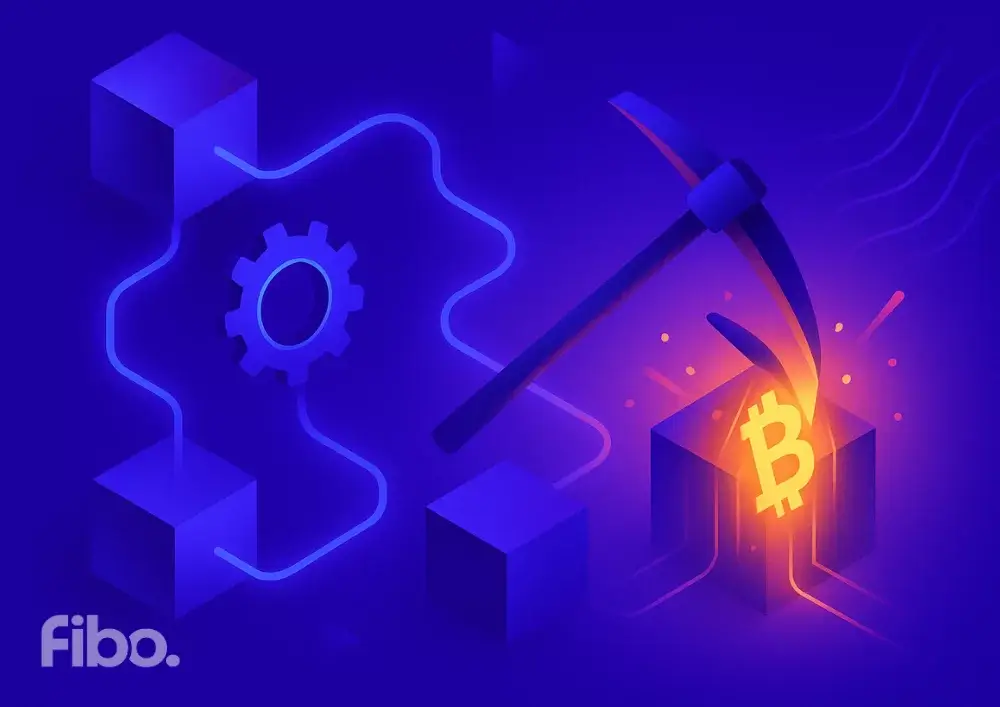
The blockchain is a public ledger. It records all Bitcoin transactions. Each transaction is grouped into a block. Once a block is full, it’s added to the existing chain of blocks. This creates a secure and transparent chain of blocks.
The blockchain has existed for a long time. It allows cryptocurrencies to easily move from one wallet to another.
Transactions
When someone wants to send Bitcoins, they create a transaction. Here are the key steps:
- The transaction is signed with a private key. The private key is similar to a very complex digital password
- It’s broadcast to the nodes—all the interconnected computers forming the Bitcoin network
- “Miners” verify that the person making the transaction has the necessary funds
Once confirmed, the transaction is added to the blockchain. This typically takes a few minutes.
Mining
Mining is the process by which new Bitcoins are created. Miners use powerful computers to solve complex mathematical problems. Here’s what happens:
- Miners compete to validate transactions
- The first to solve the problem receives a reward in Bitcoins
This process secures the network and ensures Bitcoin operates properly.
Security
Bitcoin’s security relies on its decentralization. No central authority, like a bank. This means:
- Users control their own funds
- Transactions are pseudonymous
This security attracts many users, but it also comes with risks and responsibilities. It’s important to use secure wallets to protect your Bitcoins.
In summary, Bitcoin works through a combination of blockchain, transactions, and mining. This makes it a unique and interesting investment option. By understanding these elements, you’ll be better prepared to enter the world of Bitcoin.
What is Bitcoin Used For?
Bitcoin is more than just a digital currency. It has several uses that can interest both individuals and businesses. Here are some of Bitcoin’s main functions:
1. Medium of Exchange
Bitcoin allows you to buy goods and services online. More and more merchants accept this cryptocurrency as payment. This enables fast, low-fee transactions.
2. Store of Value
Some consider Bitcoin a form of investment. Its scarcity, with a maximum of 21 million Bitcoins, makes it an alternative to assets like gold. Investors hope its value will increase over time.
3. International Transfers
Bitcoin facilitates international money transfers. Unlike banks, there are no high fees and transactions are faster. This is particularly useful for people living in countries with limited banking services.
4. Protection Against Inflation
In some countries, inflation is so severe it can halve the currency’s value in just a few weeks.
For example, Argentina experienced inflation of over 200% in 2023, then over 100% in 2024.
In simple terms, if you had €10,000 in savings at the start of 2023, you would have lost about €7,500 in value today. You’d be left with the equivalent of just €2,500 in purchasing power.
Bitcoin, as a limited asset, can offer some protection. People turn to Bitcoin to preserve their purchasing power.
5. Technological Innovation
Bitcoin is based on blockchain technology. This creates opportunities for innovations in various sectors, including finance, logistics, and even art. The blockchain enables secure and transparent transactions.
In summary, Bitcoin serves not only as a medium of exchange but also as a store of value and a means for international transfers. Its impact on the economy and technology is considerable.
Conclusion
Bitcoin isn’t simply a new form of money. It’s a true revolution in how we think about value, exchanges, and trust. By combining technology, scarcity, freedom, and security, it offers a credible alternative to traditional monetary systems.
Whether you’re curious, an investor, or just want to understand the world, exploring Bitcoin pushes you to reflect on current finance. It can also help you discover a new form of independence.
📚 Glossary
- Bitcoin : The first and most well-known cryptocurrency, created in 2009 by Satoshi Nakamoto as a peer-to-peer electronic cash system.
- Blockchain : A distributed digital ledger that records all Bitcoin transactions in chronological order across thousands of computers.
- Decentralization : A system where no single entity controls the network; instead, power is distributed among all participants.
- Satoshi Nakamoto : The pseudonym used by the unknown creator(s) of Bitcoin. Their true identity remains a mystery.
- Mining : The process of using computational power to validate transactions and create new bitcoins.
- Miner : A computer or person that participates in the mining process, validating transactions in exchange for bitcoin rewards.
- Wallet : Digital software or hardware that stores the private keys needed to access and manage your bitcoins.
- Private Key : A secret cryptographic code that proves ownership of bitcoins and allows you to authorize transactions.
- Inflation : The decrease in purchasing power of money over time, typically caused by increasing the money supply.
Frequently Asked Questions
Is it a good time to buy Bitcoin?
It’s difficult to predict market movements. That’s why many investors use DCA (Dollar-Cost Averaging): you regularly buy the same amount, regardless of price, which reduces the impact of fluctuations.
How can I buy Bitcoin?
You can buy Bitcoin on cryptocurrency exchanges like Coinbase, Binance, or Kraken. Create an account, complete identity verification, deposit funds via bank transfer or card, then purchase Bitcoin.
Is Bitcoin safe?
Bitcoin’s technology is extremely secure due to its decentralized nature and cryptographic protection. However, you must safely store your private keys and use reputable exchanges and wallets.
Can I buy a fraction of Bitcoin?
Yes! Bitcoin is divisible to 8 decimal places. The smallest unit (0.00000001 BTC) is called a “satoshi.” You can start investing with just a few dollars.
What's the difference between Bitcoin and other cryptocurrencies?
Bitcoin was the first cryptocurrency and remains the largest by market cap. Other cryptocurrencies (altcoins) often offer different features like smart contracts (Ethereum) or faster transactions (Litecoin).
📰 Sources
This article is based on the following sources:
How to cite this article: Fibo Crypto. (2026). Understanding Bitcoin: Complete Guide for Beginners. Retrieved September 28, 2026 from https://fibo-crypto.fr/en/blog/understanding-bitcoin/
The simplest way to buy, swap and manage your crypto
Available on iOS and Android. No seed phrase, fees 3.5x lower, built-in DeFi yield.